Australia's freight task reached an estimated 786 billion tonne-kilometres in 2024–25, its highest point in the series, yet that growth doesn't mean every port offers dependable capacity for oversized or non-containerised cargo. Port of Melbourne's trade statistics show break bulk throughput declining, while other Australian corridors are losing cargo even as national freight activity expands. For shippers, the primary risk isn't just a shortage of freight capacity. It's nkewa, where the right vessel, crane, terminal window and biosecurity process are available only at selected ports and only for certain commodity cycles.
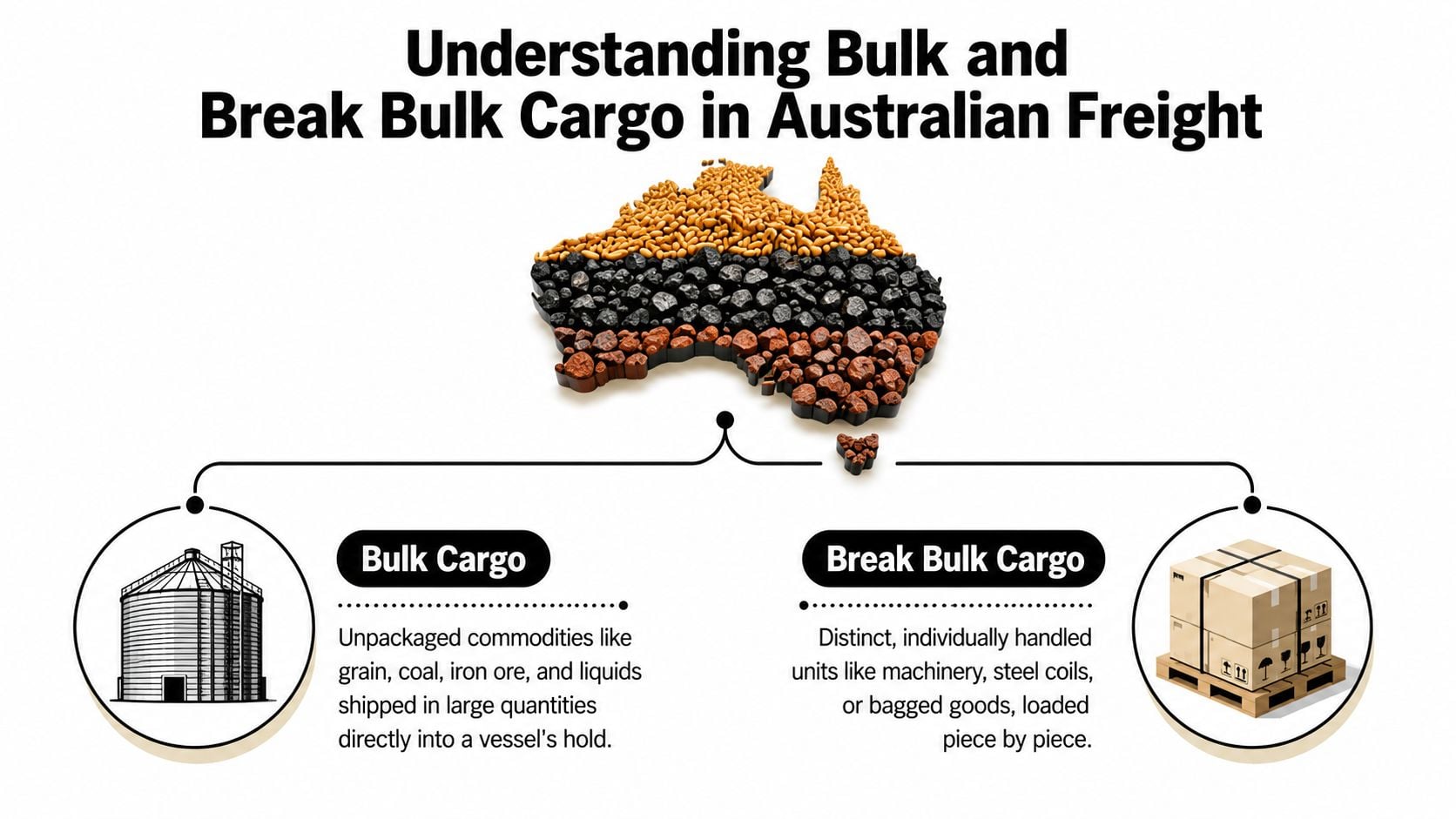
Bulk and break bulk cargo demand different operating plans. A loose commodity such as grain or iron ore moves through dedicated systems built around volume, while machinery, steel coils or project equipment needs individual lift planning, securement and coordination. Choosing the wrong category at quotation stage can lead to unsuitable terminals, unexpected handling charges and avoidable delays.
Tebulu ọdịnaya
- Understanding Bulk and Break Bulk Cargo in Australian Freight
- Operational Differences Between Bulk and Break Bulk Shipments
- Australian Port Infrastructure and Routing Considerations
- Cost Drivers and Pricing Factors for Each Cargo Type
- Documentation and Biosecurity Requirements for Australian Shipments
- Where Break Bulk Capacity Is Growing and Declining in Australia
- Practical Guidance for Shippers Choosing Between Bulk and Break Bulk
Understanding Bulk and Break Bulk Cargo in Australian Freight
BITRE estimated Australia's total bulk and non-bulk freight at 778.7 billion tonne-kilometres in 2022–23, after a pandemic-era dip to 759.7 billion tonne-kilometres in 2020–21. The figures in BITRE's freight statistics show why the distinction between bulk and break bulk cargo matters commercially. Bulk movement sits within a freight system measured at enormous scale, supported by road, rail and coastal shipping.
Bulk cargo is volume-driven
Ibu ibu consists of unpackaged commodities loaded directly into a vessel's hold, silo, tank or terminal system. Grain, coal, iron ore and liquid products are handled as a continuous flow rather than as separately counted units. Conveyors, pumps, grabs and loading chutes move the cargo, and the terminal's performance depends on uninterrupted transfers between inland transport, storage and vessel.
A bulk shipment usually makes commercial sense when the commodity is uniform, the volume is substantial and the origin and destination have compatible infrastructure. A mine, farm or processing facility may feed rail wagons into a stockyard, then transfer material through a conveyor system to a bulk carrier. The cost structure favours scale, but the shipment becomes highly dependent on terminal availability and the timing of each hand-off.
Break bulk is unit-based
gbajie nnukwu ibu moves as individual pieces or smaller consignments. Steel coils, bagged goods, machinery, vehicles, crated equipment and project components may all fall into this category. Each unit needs its own description, dimensions, weight, lifting points and securement plan.
The practical distinction is straightforward. If cargo is poured, pumped or conveyed as a homogeneous product, it's likely bulk. If a stevedore needs to identify, lift, place and secure each piece, it's break bulk. That classification affects vessel selection, terminal access, inland transport, insurance review and the way the freight forwarder prepares documents.
Port handling adds another layer. Understanding what stevedores do helps clarify why a break bulk shipment can't be treated as a simple port delivery. The stevedore coordinates cargo handling at the berth, while the shipper must ensure the freight arrives in a condition and format that can be safely worked.
Iwu bara uru: Decide whether the cargo is loose, uniform and flow-handled, or individually handled, before asking for a freight rate. A low ocean rate is irrelevant if the receiving port can't handle the cargo safely.
Operational Differences Between Bulk and Break Bulk Shipments
Bulk and break bulk shipments can share a port, but their operating sequences are quite different. Bulk cargo preparation focuses on commodity condition, segregation and flow into the vessel. Break bulk preparation starts with the physical characteristics of every item, including lifting points, centre of gravity, packaging, dimensions and route restrictions.
Handling methods shape the shipment
Bulk carriers are designed for loose commodities in large holds. Terminals use equipment such as grab cranes, conveyor belts, hoppers and pneumatic unloaders. The shipper's priority is to maintain a clean, controlled flow and prevent contamination, moisture exposure or incorrect cargo allocation.
General cargo and multi-purpose vessels provide more flexibility for break bulk. They may carry machinery, steel, crates, bagged goods and other units in the same voyage. Cargo can be lifted with shore cranes or vessel gear, then positioned according to a stowage plan. Lashings, dunnage, chocks and blocking keep pieces stable during the voyage.
| atụmatụ | Ibu ibu | Gbajie ibu ibu |
|---|---|---|
| Cargo form | Loose, unpackaged and generally homogeneous | Individual units, bundles, pallets, crates or irregular pieces |
| Main vessel type | Bulk carrier, tanker or specialist bulk vessel | General cargo or multi-purpose vessel |
| Ụzọ ntinye | Conveyors, grabs, pumps or pneumatic systems | Cranes, slings, spreaders and forklifts |
| Terminal requirement | Dedicated storage, stockyard and flow-handling equipment | Berth access, lifting capacity, staging area and securement resources |
| Preparation focus | Commodity quality, segregation, moisture and weight records | Dimensions, lifting points, packing, stowage and lashing |
| Cost exposure | Volume, terminal access, vessel scale and waiting time | Labour, crane time, stowage complexity and individual handling |
| Documentation emphasis | Commodity description, grade, quantity and certificates | Piece-level packing list, weights, dimensions and handling instructions |
Preparation errors become operational delays
A break bulk packing list that omits a crate's actual height can invalidate the inland route or lifting plan. A machinery description that doesn't identify its lifting points forces the terminal to stop and clarify the move. For bulk cargo, an incorrect commodity description or missing quality record can affect acceptance, segregation and clearance.
Air transport is a separate option where the cargo and timing justify it. Ụgbọ njem ụgbọ elu covers air cargo services designed around different goods and transport requirements, but air handling doesn't remove the need for accurate weights, dimensions and regulatory documents.
The best method isn't always the one with the lowest quoted freight line. Bulk is efficient when the infrastructure matches the commodity. Break bulk is practical when the item can't be packed or handled economically as a standardised unit, but it needs more planning at every physical transfer.
Australian Port Infrastructure and Routing Considerations
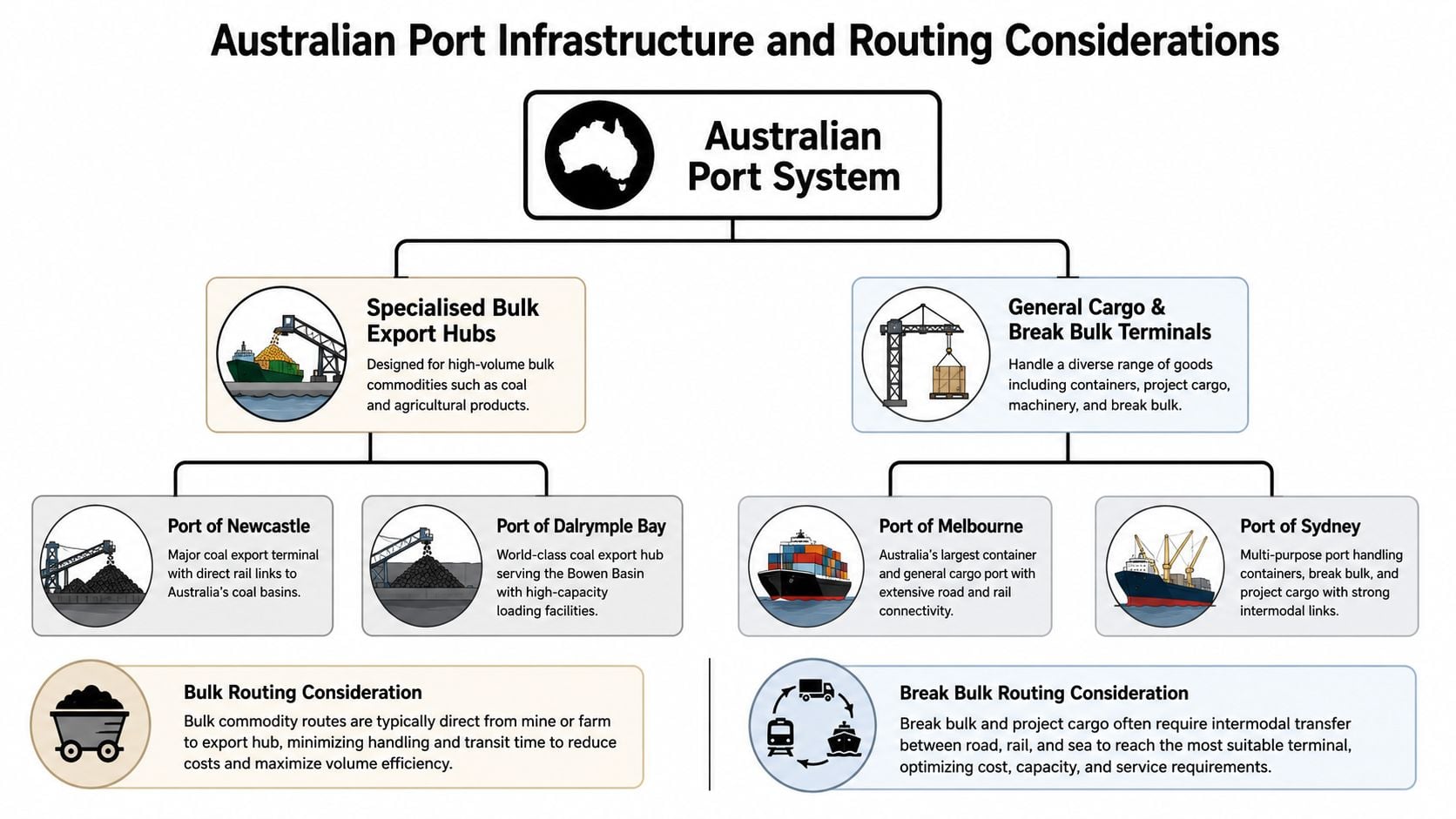
Port selection in Australia starts with the cargo, not the preferred shipping line. A loose resource commodity normally follows an established mine-to-export or farm-to-export corridor. An oversized machine may need a berth with suitable water depth, heavy-lift equipment, laydown space, road access and a terminal willing to manage non-standard cargo.
Bulk routes depend on concentrated hubs
Australia's bulk port system is concentrated in specialist export locations. BITRE recorded Port Hedland, Dampier and Newcastle as dominant bulk terminals, with throughput of 1,490 million tonnes, 1,444 million tonnes and 1,028 million tonnes respectively over 2001–02 to 2011–12 na ya Australian port infrastructure report. That concentration means a shipper can't assume that a nearby general cargo berth offers an equivalent alternative.
Rail-to-berth synchronisation is central to these corridors. Stockyards need enough capacity to absorb variations in rail arrival and vessel timing, while conveyors and shiploaders must remain available. Maintenance planning also matters. Operators monitoring assets such as conveyors can use resources on belt conveyors condition monitoring to understand how equipment reliability affects cargo flow and berth performance.
Break bulk routing needs a physical survey
For break bulk, confirm the following before booking:
- Cargo geometry: Record length, width, height, gross weight, centre of gravity and lifting points for every unit.
- Terminal capability: Ask whether the berth has suitable cranes, spreaders, forklifts, staging areas and weather protection.
- Inland route: Check bridge limits, turning space, overhead clearances and any required escort arrangements.
- Port process: Confirm discharge windows, stevedore attendance, biosecurity coordination and storage rules.
- Fallback options: Identify another feasible port only if it can handle the same vessel, equipment and inland route.
Australian cargo trains can be part of a practical intermodal plan, particularly where the origin or destination is connected to established rail infrastructure. The cargo trains in Australia resource provides relevant background for shippers assessing that mode.
Coastal shipping can support domestic movement, but it isn't automatically a flexible substitute for road transport. Vessel schedules, port calls, berth access and cargo compatibility all influence the result. Personal relocation cargo follows a different process again, so Bubata ngwa ahịa nkeonwe na Australia shouldn't be treated as a project freight routing guide.
Cost Drivers and Pricing Factors for Each Cargo Type
Bulk shipping usually earns its cost advantage through scale. A large, uniform parcel can use a vessel and terminal designed for rapid flow, spreading fixed handling and voyage costs across the cargo. That advantage disappears if the shipment must wait for a compatible berth, miss a loading window or use a less suitable terminal.
Port activity illustrates the scale of bulk handling. Fremantle Ports' 2022–23 trade summary akụkọ 14,575,488 mass tonnes of dry bulk na 7,413,561 mass tonnes of liquid bulk, maka ngwakọta 21,989,049 mass tonnes of bulk cargo handled at the port.
Where bulk budgets move
Bulk cost planning should include:
- Terminal charges: Loading, unloading, storage and transfer through specialist equipment.
- Inland positioning: Rail or road delivery into the terminal, including any waiting caused by terminal windows.
- Commodity preparation: Cleaning, testing, grading, treatment or segregation where required.
- Vessel timing: Delays can create exposure to berth-related charges, storage and vessel waiting costs.
- Quantity accuracy: Under-declaring or overestimating the parcel can disrupt the planned vessel and terminal sequence.
Break bulk pricing is less predictable because the cargo creates work unit by unit. Crane mobilisation, rigging, dunnage, lashing, stevedoring, survey attendance and staging space can all affect the final cost. A smaller port may offer a shorter inland route, but the saving can disappear if suitable lifting equipment must be brought in or the vessel needs to wait for a compatible berth.
The costs shippers miss
The most common budget failures happen before the vessel sails. A shipper provides estimated dimensions, then discovers the actual crate is taller than the route allows. Another books a vessel but hasn't confirmed whether the destination terminal can discharge the heaviest piece. A third assumes port storage is available while biosecurity or customs clearance remains pending.
The cheapest break bulk quote is often the one that has omitted a handling assumption. Ask what the price includes at the berth, during staging, during securement and after discharge.
For both cargo types, ask for a written breakdown of port charges, stevedoring, equipment, storage, inspections, lashing and inland delivery. Cost control comes from accurate cargo data and confirmed operating windows, not from comparing ocean freight alone.
Documentation and Biosecurity Requirements for Australian Shipments
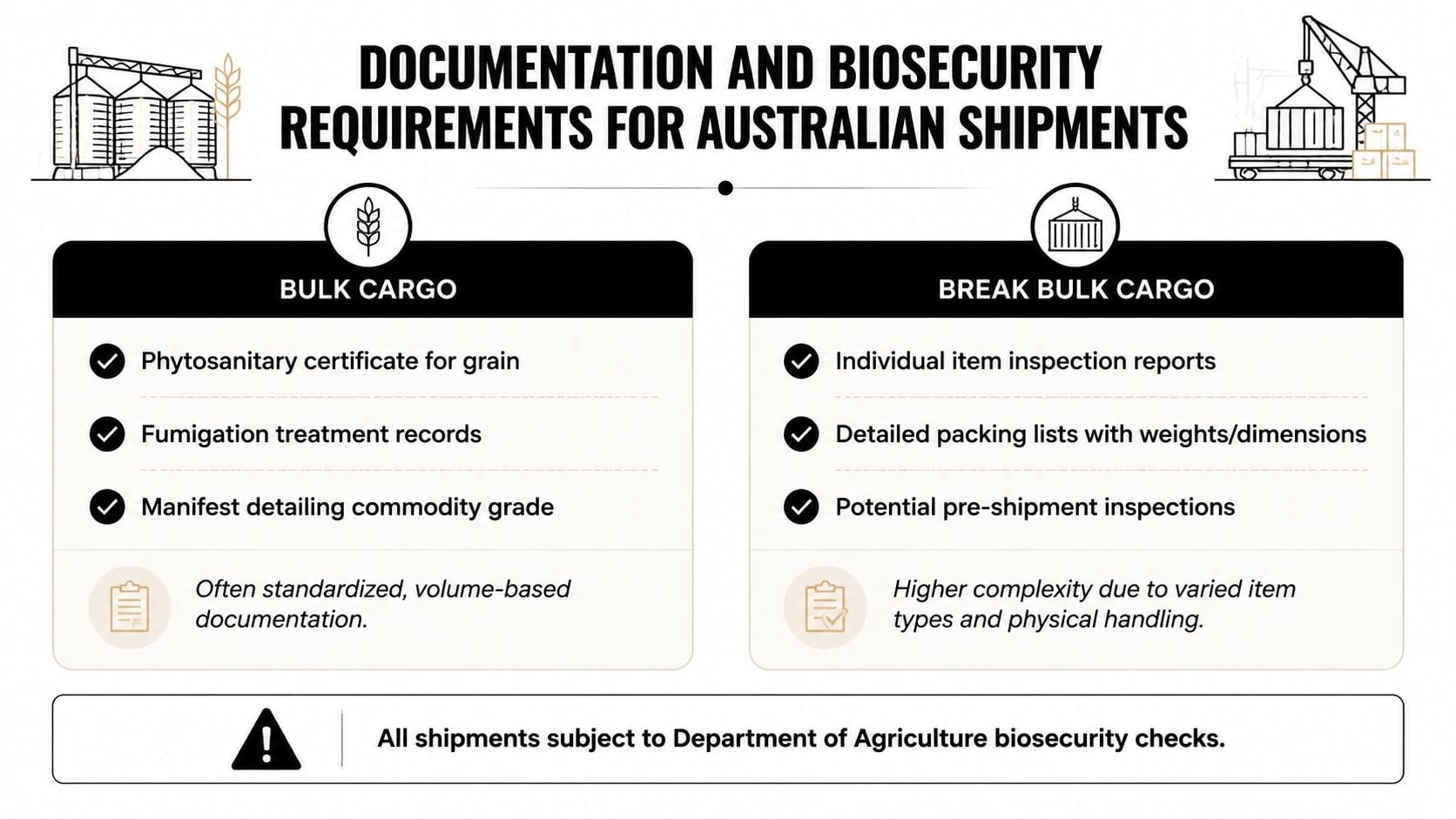
Documentation must match the cargo's physical form and the way Australian authorities will assess it. For bulk cargo, the file usually includes a commercial invoice, quantity or packing details, commodity certificates, quality information, treatment records and transport documents. The description should identify the commodity, grade or type, origin and quantity presented for clearance. A vague product name can create questions even when the shipment itself is straightforward.
Break bulk needs an item-level record. Each crate, bundle, machine or other piece should correspond with the packing list. Provide gross and net weights where relevant, final dimensions, marks and numbers, lifting points, dangerous goods information where applicable, and treatment or cleanliness records required for the cargo. These details also give the terminal and stevedores the information needed to plan handling safely.
Break bulk needs coordinated attendance
The Department of Agriculture, Fisheries and Forestry's break-bulk discharge arrangements achọrọ pre-booked biosecurity attendance, port-specific discharge procedures and shore-side coordination before cargo can be cleared. The arrangements cover named ports including Sydney, Newcastle, Port Kembla, Brisbane, Melbourne, Adelaide and Darwin.
The booking must fit the vessel schedule and terminal plan. The importer, broker, forwarder, terminal, vessel operator and biosecurity officers need the same cargo information before discharge starts. If attendance is not booked, or the terminal has not received the applicable discharge instructions, cargo can remain on the wharf while an administrative issue is resolved. That delay may also disrupt berth labour, equipment allocation and onward transport.
Use a shipment-level checklist
- Confirm the commodity: Keep the commercial description, tariff classification and biosecurity information consistent across all documents.
- Reconcile quantities: Match the manifest, invoice, packing list and transport document to the same units or bulk quantity.
- Verify physical details: Check final packed dimensions and weights against the lifting and discharge plan.
- Prepare treatment evidence: Retain fumigation, cleaning, treatment and origin records where required.
- Book the port process: Confirm discharge procedures, attendance requirements and contact points before arrival.
- Review the commercial invoice: lelee ihe achọrọ maka akwụkwọ ọnụahịa azụmaahịa against the transaction and cargo description.
A complete document set can still cause delay when parties use different cargo names, quantities or measurements. One consistent version helps customs, biosecurity and terminal teams release the shipment without avoidable clarification.
Where Break Bulk Capacity Is Growing and Declining in Australia
Break bulk capacity is fragmented across Australian ports, terminals, vessel services and commodity corridors. The result is uneven access: a port may handle substantial general freight while a specific break bulk service contracts or disappears.
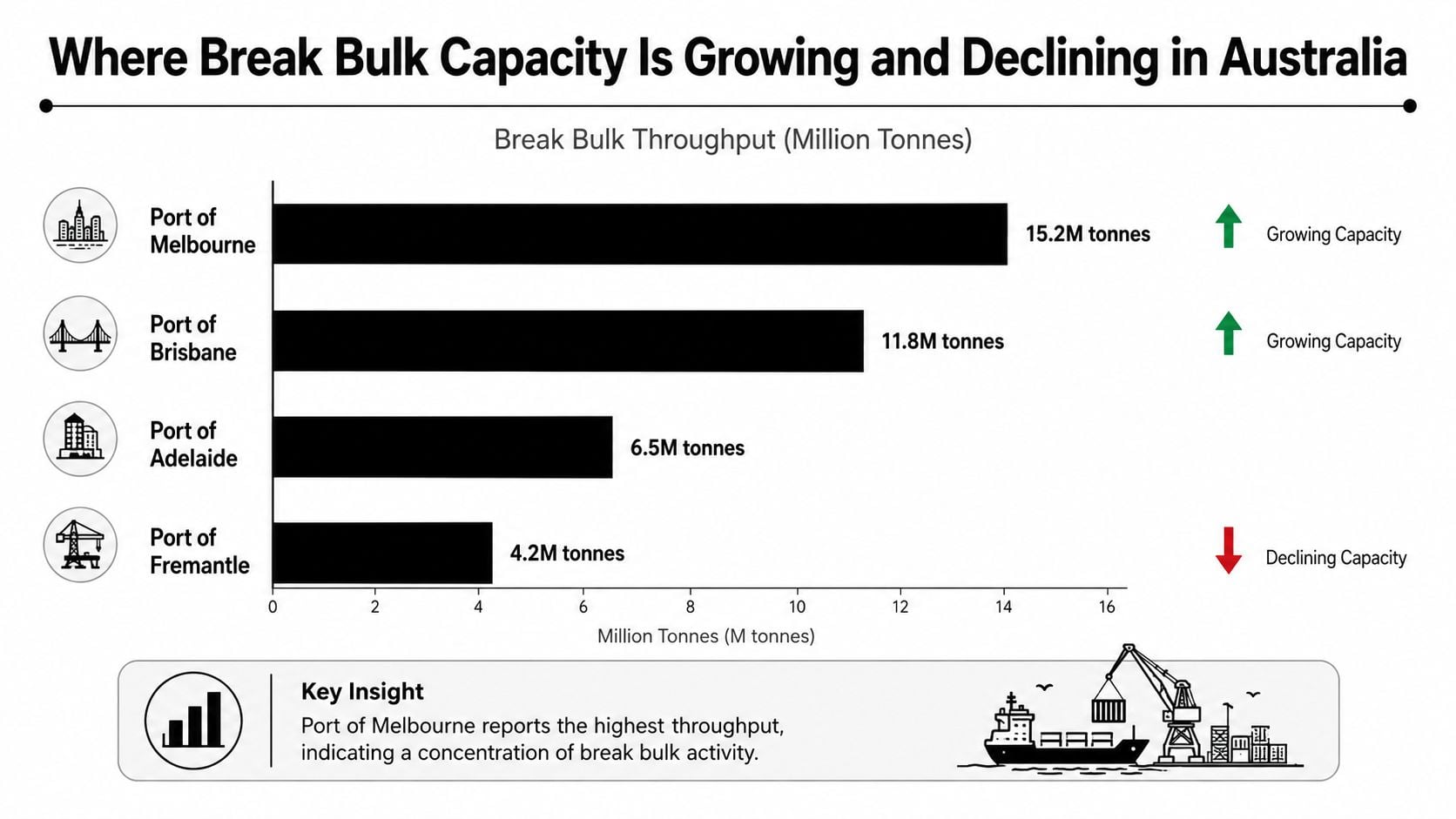
Port of Melbourne's trade performance data ndia 9.7 million revenue tonnes of break bulk throughput in 2024–25, ala 4.0% kwa afọ. North Queensland Bulk Ports reports break bulk falling to 28,514 tonnes in 2024–25, si 160,514 tonnes in 2021–22. Across Australia, the broader freight task reached an estimated 786 ijeri tonne-kilomita n'afọ 2024-25.
These figures show why national freight growth cannot be treated as proof of local break bulk reliability. Energy, resources and infrastructure cycles alter cargo volumes, vessel calls and terminal priorities. A project may therefore face fewer suitable sailings even while nearby port activity appears strong.
Fragmentation creates practical risk
For oversized cargo, the relevant question is whether a port can handle the required lift, storage period and onward movement. Overall throughput is only a starting point. Busy berths can bring competition for labour, cranes and staging space, especially near terminals serving resource exports.
North Queensland's decline also challenges route assumptions based on past shipments. A port that previously accepted similar cargo may now offer fewer vessel calls, less terminal attention or different staging arrangements. Confirm current capability with the terminal, stevedore and carrier before fixing the booking.
The following video provides visual context for cargo handling decisions and port movement:
A less obvious port can provide the better operating plan if its inland route, handling requirements and total cost remain workable. Compare terminal capability, vessel schedules, lifting equipment, storage availability and final delivery constraints as one routing decision. That approach exposes capacity gaps before cargo reaches the wharf, when changing ports becomes expensive and time-consuming.
Practical Guidance for Shippers Choosing Between Bulk and Break Bulk
Choose bulk when the cargo is a high-volume, uniform commodity moving through an established corridor with compatible storage, rail, conveyor or pumping infrastructure. The model is efficient, but it's tied closely to terminal capability and vessel scheduling.
Choose break bulk when the cargo is oversized, irregular, heavy, mixed or unsuitable for standard packing. Project equipment, steel products and one-off industrial units often need the direct control that individual lifting and securement provide. That flexibility comes with more exposure to handling time, crane availability, stowage decisions and port-specific procedures.
Tupu ị tinye aka, jụọ:
- Can the origin and destination terminals handle the cargo's actual dimensions and weight?
- Does the vessel offer the required gear, hold configuration and deck space?
- Who is responsible for lashing, dunnage, surveys and crane mobilisation?
- Have biosecurity attendance and discharge procedures been confirmed?
- Does the insurance cover handling, storage, inland transit and the cargo's declared condition?
- Can the forwarder coordinate road, rail, stevedoring, documentation and delivery as one plan?
A freight partner should understand both the physical cargo and the commercial consequences of each route. AUSFF handles sea freight options including LCL and FCL, documentation management and door-to-door coordination, with project logistics capabilities relevant to heavy equipment and oversized freight. Surely we can assist with comparing a bulk-style movement, a break bulk plan or a combined approach where standard goods and awkward units need different handling.
AUSFF can help assess sea freight options, prepare shipment documentation and coordinate the port-to-door movement for bulk-related and break bulk requirements. Visit AUSFF with your cargo dimensions, weights, origin and destination so the routing discussion starts with the information terminals and carriers need.