Your online orders are growing, but the Sydney 3PL quotes still look deceptively simple. One provider offers a cheaper outer-West warehouse, another promises faster carrier access closer to the city, and a third has modern space that appears ideal until you ask about returns, Amazon preparation, inventory visibility, and cut-off times. The lowest storage rate may not produce the lowest cost per delivered order.
Till plan a logistics 3PL Sydney warehouse properly, start with the operating model rather than the building. Match facility grade, precinct access, freight mode, systems, handling requirements, and contract terms to the way your customers buy. Surely we can assist, but the right decision still begins with a disciplined comparison of cost-to-serve.
Innehållsförteckning
- Why Sydney 3PL Planning Starts With Cost-to-Serve
- Building a Vendor Shortlist That Actually Filters
- Setting Up the Warehouse for Real Fulfilment
- WMS, E-Commerce, and Amazon Prep Integrations
- Freight, Customs, and Bonded Storage Choices
- Contract Terms, SLAs, and the Cost Line Items to Lock Down
- Your 90-Day Rollout Timeline From Shortlist to Go-Live
Why Sydney 3PL Planning Starts With Cost-to-Serve
A growing e-commerce seller recently had three workable Sydney options. The first was an outer-South-West facility with Western Sydney net face rent of $200 to $300 per square metre in Q2 2026, Enligt Knight Frank's Sydney industrial market report. The second was a closer-in warehouse at the upper end of that range. The third was a modern speculative building with useful clear height and automation potential, but a longer lease lead time and uncertain fit-out timing.
The outer precinct looked cheaper on the quote. Its carrier collection window put more pressure on same-day dispatch, line-haul took longer, and some delivery lanes carried extra transport costs. The closer facility cost more per square metre, but shortened the distance between inventory, carrier networks, and customers. The modern building looked strong operationally, yet “available” did not mean ready for the required racking, packing benches, returns area, or integration testing.
The right comparison is the lowest landed cost per order, with service levels protected and capacity for sensible growth. Rent remains part of the calculation, not the decision rule.
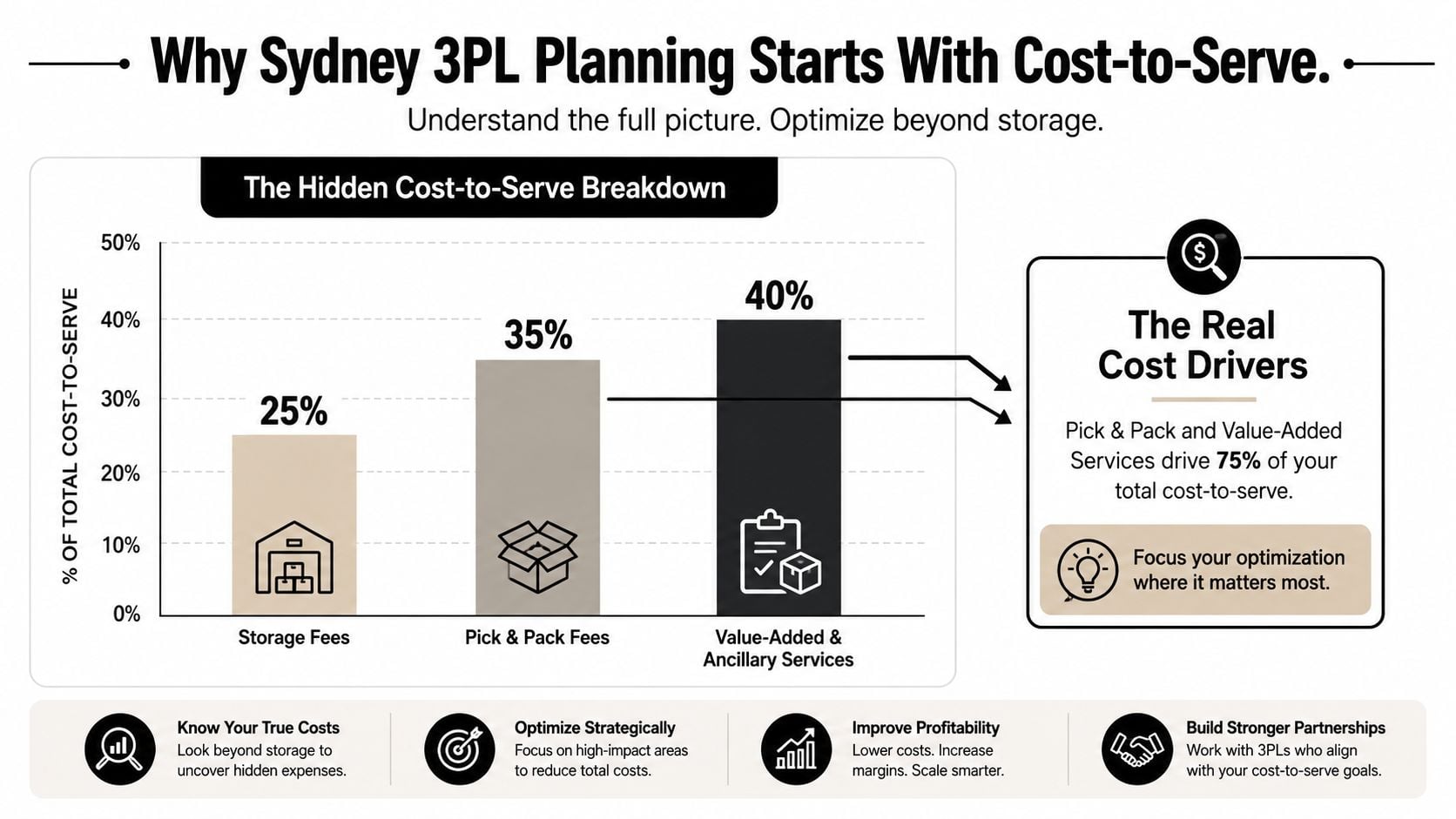
Storage and pick fees rarely show the full operating bill. Include receiving, put-away, packaging, relabelling, kitting, returns, carrier surcharges, failed-delivery handling, stock investigations, and urgent replenishment. Start by checking how avgifter för lagerhållning are calculated, then build a cost model from actual order flows, shipment profiles, and exception volumes.
Read the market behind the vacancy headline
Sydney remains a constrained industrial and logistics market, although published vacancy figures use different methods and coverage. JLL reported 23.5 million square metres of industrial stock and a Q1 2026 vacancy rate of 5.8% JLL's Australian industrial vacancy analysis. CBRE reported 3.5% in 1H26, and Cushman & Wakefield reported 3.8% under andra kvartalet 1. Those figures should be read within each provider's methodology rather than treated as interchangeable.
The operational conclusion is consistent. Suitable warehouse space is harder to secure than a city-wide vacancy label suggests. Prime sites can disappear before due diligence is complete, while older stock may be available but unsuitable for efficient fulfilment.
JLL-linked reporting showed secondary vacancy rising from 4.8% till 5.4%, while the same market update placed super-prime vacancy at 6.8% JLL's Australian industrial vacancy analysis. This split reflects a flight to quality. Modern facilities can support better racking, cleaner pick paths, automation planning, compliance controls, and customer presentation. A low-cost secondary shed can add labour and handling costs that exceed the rent saving.
Treat available space as a specification problem
Knight Frank reported that speculative developments represented 42 % av det totala utbudet in Sydney's industrial market, with Western Sydney vacancy at about 738,000 kvadratmeter and new 2026 supply expected to reach about 650,000 kvadratmeter. More properties create choice, but they do not guarantee the right operating layout.
Sydney is also forecast to receive 1,385,700 square metres of new warehouse space over the next 12 months, Med en 58% pre-commitment rate across stock under construction, according to Real Estate Asia's Sydney warehouse market report. Future supply may improve options, but waiting for it can leave a 3PL without a workable interim plan.
Before comparing vendors, confirm:
- Precinct access: Map carrier routes, port access, major motorways, customer density, and collection cut-offs.
- Facility grade: Check clear height, floor loading, fire systems, dock configuration, security, food-grade suitability, and automation readiness.
- Lease timing: Ask when the space can receive stock, when fit-out can begin, and which assumptions depend on landlord approval.
- Operativ passform: Test whether receiving, picking, packing, returns, and cross-docking can operate without congestion.
Sydney's road and rail freight task shows why location affects more than rent. BITRE reported that in 2024–25 rail moved about 447 billion tonne-kilometres of freight, while road moved about 253 billion tonne-kilometres, as recorded in the Australian Infrastructure and Transport Statistics freight data. Model transport time and handling effort alongside storage charges, especially when comparing outer-precinct affordability with inner-Sydney carrier access.
Building a Vendor Shortlist That Actually Filters
A sales presentation can make almost any 3PL look capable. A useful shortlist forces each provider to answer the same operational questions, show the same evidence, and complete the same pilot conditions.
Börja med three to five vendors. Score them before site visits, then update the scores only when the provider supplies verifiable information. Don't let a polished facility tour outweigh weak exception handling or an undocumented integration.
3PL Vendor Scoring Framework
| Kriterium | Vikt | Vad som ska verifieras | Röd flagga |
|---|---|---|---|
| Plats och operatörsåtkomst | Hög | Collection windows, route coverage, line-haul assumptions, port and motorway access | The provider quotes distance but won't confirm cut-off performance |
| WMS capability | Hög | Live inventory, lot and serial controls, order status, reporting, APIs and webhooks | Inventory visibility depends on manual spreadsheets |
| Bärarblandning | Hög | Carrier options, label generation, tracking events, collection processes | One carrier is presented as suitable for every order profile |
| Specialty handling | Medium | Fragile, liquid, textile, regulated, and Amazon preparation procedures | The provider says “we can handle it” without a documented SOP |
| Lagringsvillkor | Medium | Pallet, bin, square metre, overflow, minimums, and access charges | The quote excludes ancillary storage and handling fees |
| Onboarding approach | Hög | Test orders, inventory reconciliation, training, escalation path, go-live criteria | No written project plan or named implementation owner |
Ask for sample operational reports before contracting. You want to see inventory accuracy reporting, on-time dispatch reporting, order status definitions, returns records, and an example exception log. Industry benchmarking places Australia's logistics performance in a global context through the Världsbankens logistikprestandaindex, but a national benchmark won't replace account-level evidence from your prospective provider.
A credible pilot should include ordinary orders, multi-line orders, address corrections, split shipments, returns, damaged cartons, backorders, and an order received close to the agreed cut-off. Compare the WMS record with the physical result and carrier scan. If you're assessing transport providers separately, a practical resource on how to compare container haulage providers can help structure the carrier portion of the review.
Praktisk regel: Don't approve a 3PL because it passes a site tour. Approve it because it passes the same test orders your customers generate.
Setting Up the Warehouse for Real Fulfilment
A warehouse can have modern walls and still fail at fulfilment. During a site visit, follow one SKU from arrival to storage, picking, packing, dispatch, return, and restock. Any stage that relies on an improvised trolley, shared bench, handwritten note, or verbal instruction deserves investigation.
Start with the physical flow. Receiving needs enough space to inspect cartons without blocking outbound work. Returns need a quarantine area, reason-code process, condition assessment, and a clear decision on whether stock goes back into saleable inventory. A cross-dock zone should sit close to dispatch, not become a temporary dumping ground.
Match storage to the product
Fragile goods need more than a “handle with care” label. Ask whether the provider uses double-wall cartons where appropriate, foam inserts, product separation, and documented packing standards. If damage risk is material, require a practical drop-testing process and review how the warehouse records packaging changes.
Liquids need upright storage, leak containment, compatible packaging, and labels that help staff identify handling requirements. The 3PL should explain how it isolates damaged units and cleans a spill without interrupting adjacent orders. Textile products raise different questions, including hang versus fold storage, polybag standards, barcode placement, lint control, and preparation for marketplace requirements.
For Amazon-bound stock, inspect the labelling and prep bench rather than accepting a general capability statement. The Wisenet Security Ltd SME guide is also useful context when reviewing CCTV, access control, alarm coverage, visitor procedures, and monitoring design.
Walk the safety controls
Check pedestrian and forklift separation, dock access, emergency exits, pallet condition, housekeeping, manual-handling controls, and contractor access. In a multi-tenant building, ask who controls common areas and how incidents are escalated.
Your site-visit checklist should include:
- Tar emot: Appointment process, inspection space, discrepancy recording, and put-away timing.
- Plockning: Slotting method, replenishment triggers, scan controls, and congestion points.
- Förpackning: Bench capacity, packaging standards, weigh-and-dimension capture, and label checks.
- Returnerar: Quarantine, inspection, restocking, disposal, and customer-credit instructions.
- Säkerhet: CCTV coverage, access permissions, visitor logs, and incident reporting.
- Säkerhet: Traffic separation, training records, emergency procedures, and manual-handling controls.
A provider that can describe the work sequence in detail is easier to manage than one that only describes the building.
WMS, E-Commerce, and Amazon Prep Integrations
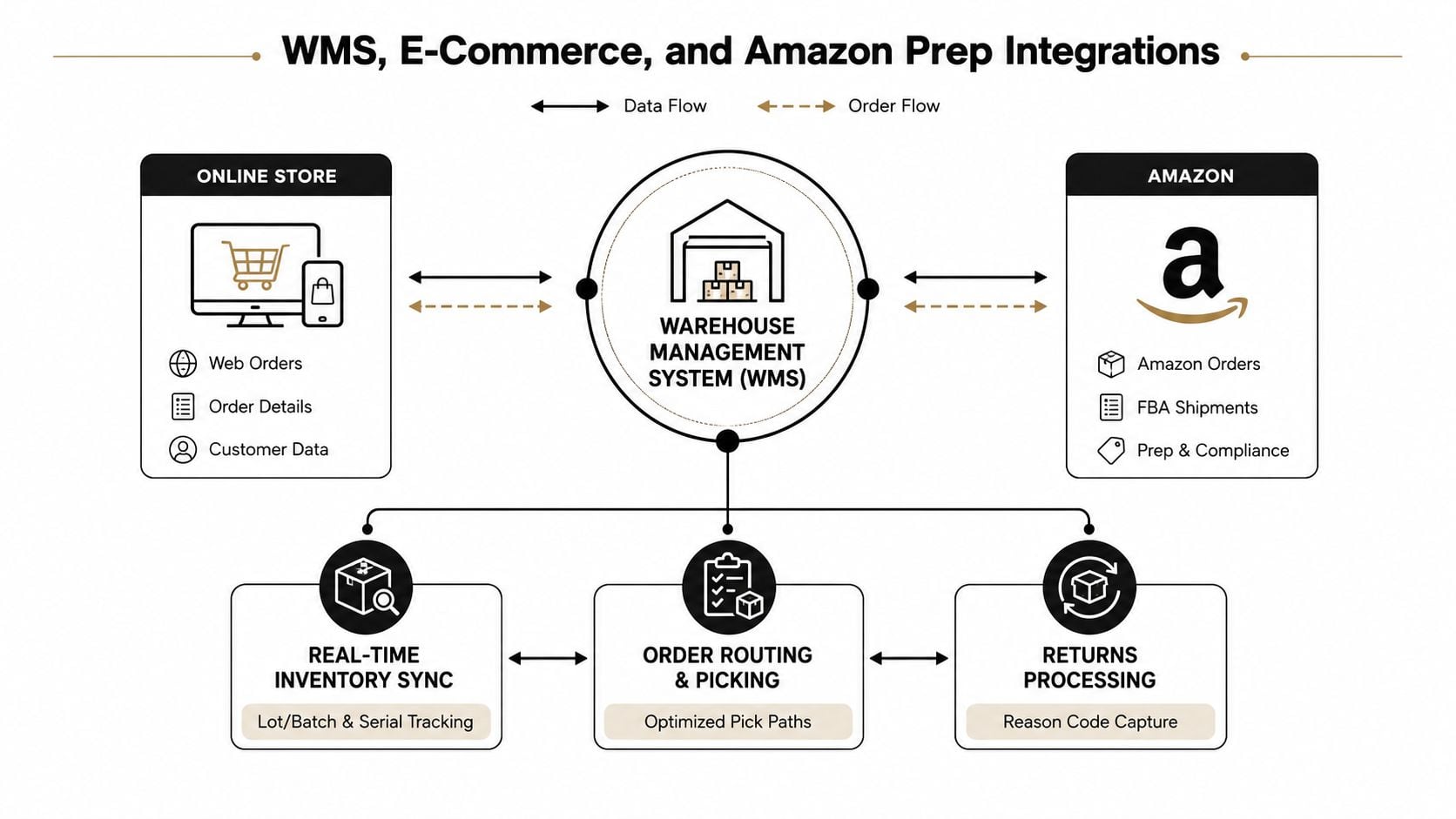
The warehouse becomes a fulfilment engine only when the order, inventory, carrier, and returns data agree. Specify the required system behaviour before you compare software screenshots.
At checkout, the e-commerce platform should send a complete order to the WMS. The WMS should validate stock, reserve units, route the order, create a pick task, record each scan, confirm packing, generate the carrier label, and return tracking to the selling channel. When the carrier accepts the parcel, the status should update again. A return should create a linked record with a reason code, inspection result, disposition, and inventory adjustment.
Specify the minimum viable integration
Require the 3PL to confirm:
- Inventarieöverblick: Stock on hand, allocated stock, available stock, damaged stock, and location records update without avoidable manual intervention.
- Product controls: Lot or batch tracking, expiry handling where relevant, serial capture, barcode validation, and unit-of-measure rules.
- Order ingestion: Shopify, Amazon, eBay, TikTok Shop, or other channels can send orders through documented APIs or webhooks.
- Carrier connectivity: Labels, tracking events, service selection, address validation, and failed-delivery updates flow back to the correct channel.
- Returnerar: Reason codes, inspection outcomes, restocking decisions, and refunds or replacement instructions remain traceable.
A warehouse management integration guide can help your team prepare questions for the technical discovery session. The provider should also supply sandbox access or a test environment where possible, along with field mapping and error-handling procedures.
Amazon preparation requires its own work instructions. Confirm FNSKU labelling, polybagging, suffocation warnings, box content statements, carton labels, and the distinction between FBA and FBM orders. One Sydney facility may support both flows, but the WMS must route the orders to different packing and dispatch rules. A practical overview of Amazon förberedande tjänster can help frame that discussion.
For urgent or high-value replenishment, Flygfrakt provides cargo services designed for varied global supply-chain requirements. The warehouse system should identify those inbound shipments clearly, so receiving staff can prioritise them without losing normal inventory controls.
Freight, Customs, and Bonded Storage Choices
A Sydney retailer facing a launch deadline may accept an airfreight premium to prevent a stockout, while a steady replenishment program can justify sea freight. The right mode follows urgency, shipment profile, inventory exposure, and the access requirements of the destination.
Use a repeatable lane decision:
- Brådskande karaktär: Choose air when a stockout or launch delay costs more than the freight premium.
- Leveransstorlek: Use LCL for smaller or irregular volumes, allowing for consolidation handling.
- Container efficiency: Select FCL when the SKU mix, load profile, and replenishment cycle can use a container efficiently.
- Inventory value: Match the mode to the financial exposure of goods held in transit.
- Destination rules: Check restrictions imposed by the carrier, customs broker, or destination authority.
Sydney's constrained industrial market makes the warehouse location part of this calculation. An outer precinct may reduce occupancy costs, but longer drayage and slower carrier access can raise the cost to serve inner-Sydney customers. Match the facility and freight plan to your channel mix rather than choosing on rent alone.
The warehouse plan must separate ordinary storage from bonded operations. Australian Border Force sets formal obligations and conditions for warehouses operating under the Integrated Cargo System, so bonded or imported cargo requires controlled processes. Review the Australian Border Force warehouse obligations before committing to the operating model, and compare those requirements with a tulllager setup suited to your inbound flow.
Customs errors rarely stay confined to the customs file. They can delay receiving, disrupt inventory availability, and create customer-service work.
Assign ownership for tariff classification, commercial documents, customs entry instructions, duty and tax handling, inspections, and discrepancy resolution. If the workflow needs a Sydney customs touchpoint, Custom Clearance Sydney can be included in the comparison, with scope confirmed rather than assumed.
For bonded storage, document release authority, WMS segregation, and the audit trail. Confirm prohibited or restricted goods before quoting. Services may be suspended to destinations including Ukraine, Russia, and Belarus, so destination eligibility belongs in the pre-shipment checklist.
Contract Terms, SLAs, and the Cost Line Items to Lock Down
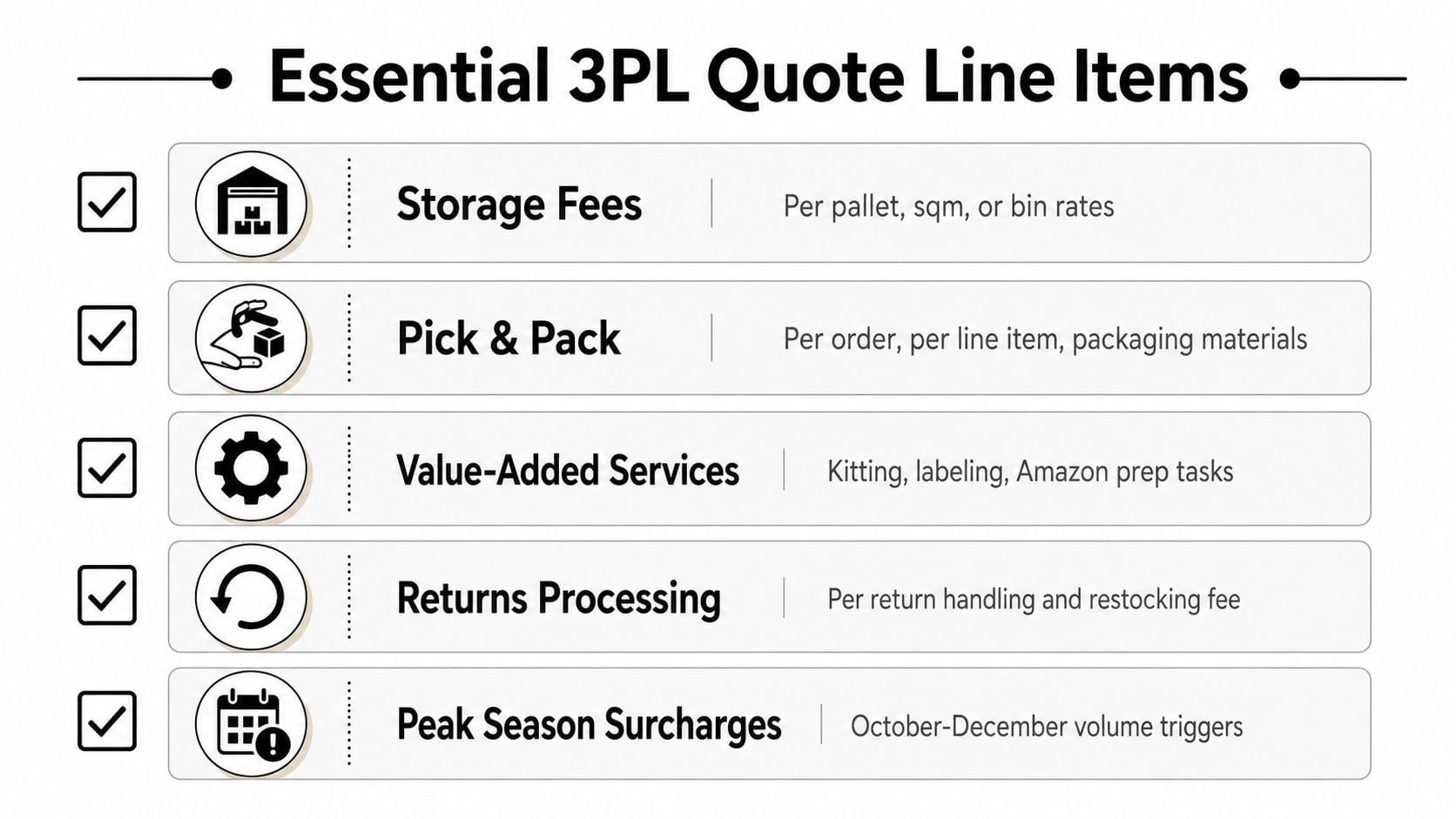
A 3PL quote becomes useful only when every charge has a definition, trigger, unit, and reporting method. Storage may be priced per pallet, square metre, or bin. Pick and pack may vary by order, line, unit, packaging type, or special handling. The contract needs to show how those categories interact.
Lock down the commercial detail
Ask the provider to define:
- Lagringsavgifter: Per pallet, square metre, bin, overflow position, and access event.
- Plocka och packa: Per order, line item, unit, carton, packaging material, and special instruction.
- Värdeskapande arbete: Kitting, labelling, relabelling, inspection, bundling, and Amazon preparation.
- Returhantering: Handling, inspection, restocking, disposal, repacking, and customer instruction.
- Peak charges: Volume triggers, notice periods, seasonal surcharges, and the applicable months.
Also review minimum monthly charges, annual increases, insurance treatment, stock-loss liability, audit rights, termination assistance, data access, and the notice required for rate changes. A cheap base rate can become expensive if the contract leaves these items open.
Turn service language into operating controls
Write the SLA around measurable events. Define order accuracy, inventory accuracy, same-day dispatch cut-off, carrier handover, exception acknowledgement, resolution targets, returns processing, and reporting cadence. Don't accept “same-day dispatch” without specifying the order receipt time, order status that qualifies, excluded conditions, and evidence used to calculate performance.
Useful negotiation wording is direct: “The provider will report order accuracy and inventory accuracy at the agreed cadence, identify exclusions, and provide supporting transaction records on request.” For stock discrepancies, define the investigation window, responsibility for count verification, liability treatment, and the chargeback or claim process.
Ask how the provider handles an address error, failed carrier collection, damaged stock, missing scan, oversell, and marketplace rejection. Those cases expose a 3PL faster than a normal order does.
Contract discipline: If a fee or service level matters to your margin, it belongs in the schedule, not in a sales conversation.
Your 90-Day Rollout Timeline From Shortlist to Go-Live
A controlled rollout gives the warehouse, technology team, carrier, and customer-service team time to test the same operating assumptions. The timeline below suits a normal transition, but the workload should reflect SKU complexity, channel count, import requirements, and the condition of your existing data.
Veckor 1 till 3
Start with the market scan and operating brief. Record order profiles, channel mix, product dimensions, handling risks, inbound modes, returns rules, target cut-offs, and delivery destinations. Send the same brief to prospective 3PLs and ask them to state their assumptions.
Score the responses, then reduce the field to three to five candidates. Review precinct access, facility grade, WMS capability, carrier mix, specialty handling, storage terms, and onboarding ownership. Reject providers that won't document their cut-offs, exception process, integration scope, or commercial assumptions.
Veckor 4 till 6
Complete site visits and walk real workflows. Inspect receiving, racking, pick faces, packing benches, returns, dispatch, security, and safety controls. Ask each finalist to produce a pilot statement of work covering responsibilities, test orders, data exchanges, stock reconciliation, escalation, and go-live criteria.
Negotiate the contract while the operational details are still visible. Lock down storage units, pick charges, value-added work, returns, peak conditions, minimums, liability, reporting, termination support, and rate-change rules.
Veckor 7 till 9
Build the integrations and clean the SKU master. Validate product dimensions, weights, barcodes, bundles, lot or serial fields, Amazon preparation rules, packaging instructions, and channel mappings. Load a controlled sample, then reconcile the WMS record to the physical count.
Run test orders through each channel. Include multi-line orders, address corrections, split shipments, returns, damaged items, and orders received near the promised cut-off. Test the carrier label, tracking callback, inventory deduction, exception status, and customer notification.
Veckor 10 till 12
Run the pilot with agreed volumes and named owners. Stress-test cut-off performance, reconcile inventory, execute a returns dry run, and review exception ageing. Don't move all stock until the pilot demonstrates a stable baseline and both teams know how to correct failures.
Use a simple go-live decision:
- Fortsätta: Critical workflows pass, open issues have owners, and reporting is live.
- Proceed with controls: Minor issues remain, but workarounds and review dates are documented.
- Fördröjning: Inventory, integration, carrier, safety, or compliance failures remain unresolved.
Download or adapt this rollout as an internal checklist, then keep it active after launch. The objective isn't a perfect first day. It's a measurable operating baseline that the 3PL and client can improve through regular KPI reviews.
AUSFF supports Australian warehousing, e-commerce fulfilment, Amazon preparation, returns, inventory handling, and air and sea freight workflows for businesses planning an integrated logistics operation. Visit AUSFF to review the available services and discuss how your Sydney 3PL requirements could fit an import-to-fulfilment plan.