Australia's container terminals exchanged 2024-25 میں 9.1 ملین TEUs, while ports recorded 32,142 port calls from 5,841 cargo vessels (Freightability Report 2026). Those figures explain why shipping logistics Australia isn't a matter of booking a vessel and waiting for delivery. Cargo enters through a small group of major gateways, then travels across a vast country where terminal access, documentation, inland transport, consolidation and biosecurity controls can determine the outcome.
For shoppers, importers and e-commerce sellers, the cheapest ocean rate often isn't the cheapest delivered option. A shipment can lose its cost advantage through poor packing, missed consolidation, storage, customs corrections or an unsuitable final-mile plan. The practical approach is to design the shipment around the cargo, gateway and destination from the start.
کی میز کے مندرجات
- آسٹریلوی فریٹ کے پیمانے کو سمجھنا
- Choosing Between Air Sea and RORO Freight
- How Freight Forwarding and Consolidation Work
- Navigating Australian Customs and Documentation
- عام شپنگ کے اخراجات اور ٹرانزٹ ٹائمز
- E-Commerce Fulfillment and Amazon Prep Services
- صحیح لاجسٹک فراہم کنندہ کا انتخاب کیسے کریں۔
- Planning Your Next Shipment From or To Australia
آسٹریلوی فریٹ کے پیمانے کو سمجھنا
In 2018–19, ocean-going ships carried about 1.69 billion tonnes, تقریبا کے لئے اکاؤنٹنگ 99.93% of freight by volume and 83.6% by value in two-way trade (Productivity Commission submission on maritime logistics). That scale is easy to miss when arranging one pallet, an online order or a single container.
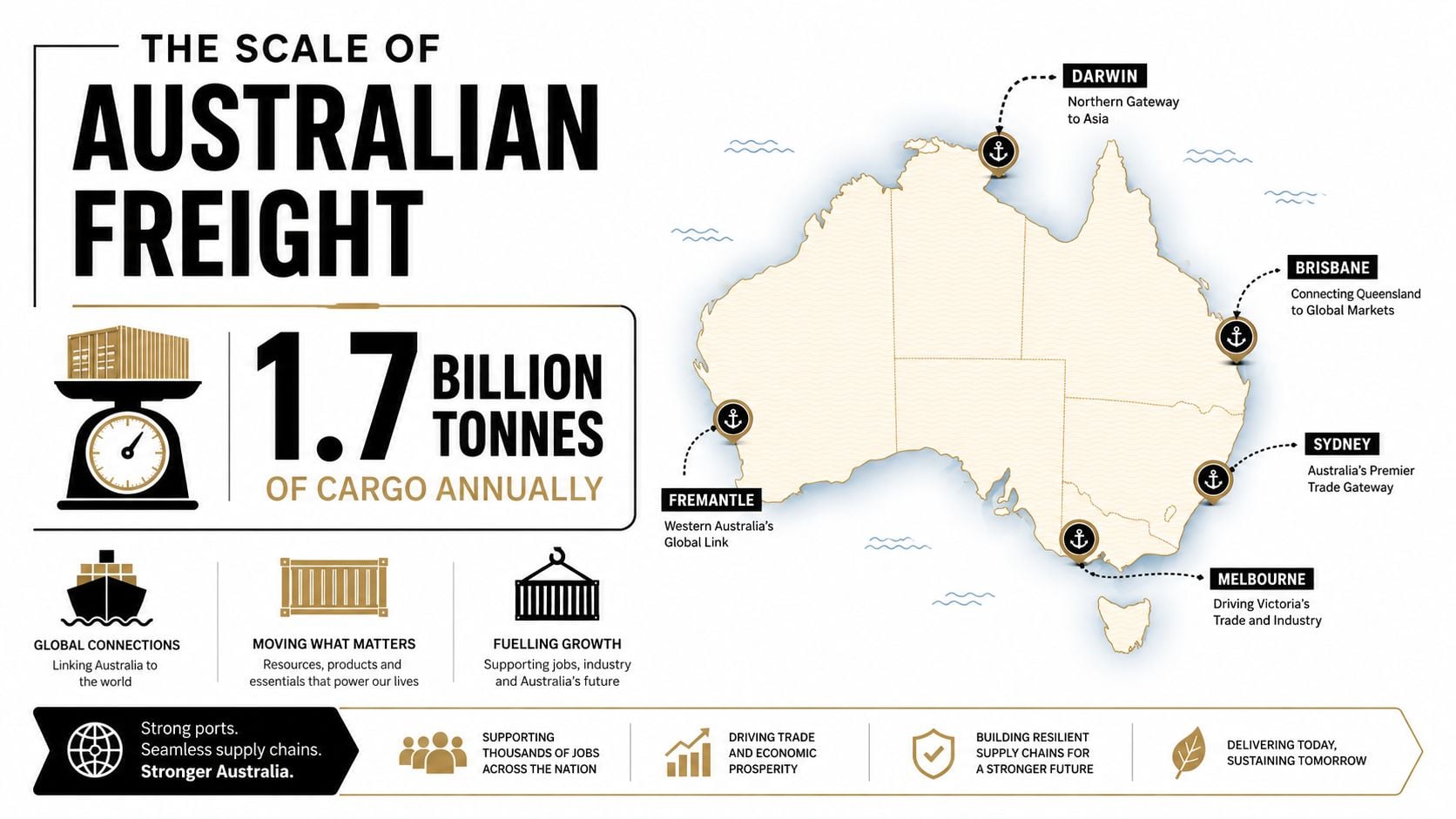
The container network is concentrated around Brisbane, Sydney, Melbourne, Fremantle and Adelaide. These terminals exchanged 2024-25 میں 9.1 ملین TEUs (Australian Logistics industry facts). This concentration provides vessel frequency and handling capacity, but it also creates exposure. A disruption at one gateway can affect vessel windows, empty-container supply, truck appointments, rail evacuation and delivery well beyond the port.
Why the gateway matters
The first operational question is not the ocean rate. It is which gateway gives the shipment the most workable end-to-end route. Melbourne-bound cargo may suit Melbourne directly, while freight for regional Queensland can face a different balance of port, rail, road and depot charges through another gateway.
Australia's maritime activity is export-heavy. In 2020–21, exports represented 88.7% of sea freight handled by tonnage، کےساتھ موازنا 5.7% for imports اور 5.6% for coastal freight (Freight Australia sea freight data). Bulk export flows shape many port operations, while container importers rely on scheduled services and dependable inland connections.
عملی اصول: Choose the destination gateway before comparing forwarding quotes. A low ocean rate can disappear when the shipment needs an expensive or unreliable inland transfer.
The coastal shipping gap
Domestic coastal shipping still moves substantial freight, but its role has declined. Freight Australia describes activity as roughly one third below its 2006–07 peak, although coastal freight moved 86.6 billion tonne-kilometres in 2024. BITRE recorded 2023-24 میں 88.3 بلین ٹن کلو میٹر، سمیت 80.3 billion bulk اور 8.1 billion non-bulk tonne-kilometres (BITRE freight statistics).
For smaller importers, the domestic leg therefore often relies on road or rail after the international vessel arrives. A container can lose its schedule after missing a terminal slot, waiting for customs or biosecurity action, or reaching a depot without a confirmed delivery appointment. Long distances between population centres make those delays expensive, particularly for oversized cargo and time-sensitive stock.
Consolidation can reduce the impact for smaller shipments, but only when the forwarder matches the cargo with the right gateway, sailing and inland service. That is the practical friction AUSFF helps address, rather than treating the ocean booking as the whole logistics plan.
Choosing Between Air Sea and RORO Freight
Freight mode selection is a commercial decision, not a habit. Sea freight generally suits dense, bulky or replenishment cargo. Air freight suits urgent, compact and higher-value goods. RORO, or roll-on/roll-off freight, is designed for vehicles, mobile machinery and cargo that can be driven or rolled onto a vessel but doesn't fit efficiently inside a standard container.
| فریٹ موڈ | لاگت کی حد (فی کلوگرام/سی بی ایم) | ٹرانزٹ ٹائم | بہترین | کلیدی حدود |
|---|---|---|---|---|
| Sea freight, LCL or FCL | Quote-dependent, usually most economical for larger volumes | Route and service dependent | Stock replenishment, bulky cargo, machinery and consolidated shipments | Longer lead time, port handling and inland delivery complexity |
| ایئر فریٹ | Quote-dependent, with pricing affected by chargeable weight | Route and service dependent | Urgent, compact, valuable or time-sensitive goods | Higher transport cost and dimensional-weight exposure |
| رورو | Quote-dependent, based on vehicle or cargo dimensions | Route and service dependent | Vehicles, plant, machinery and oversized rolling cargo | Limited sailing choices and strict cargo preparation requirements |
For a fuller operational comparison, review this air freight versus sea freight comparison. The important point is that a mode's headline rate doesn't reveal the whole cost. LCL can attract origin receiving charges, consolidation fees, destination terminal handling, unpack fees, customs costs and local delivery charges. Air freight can look expensive per kilogram, but a small shipment may avoid several fixed sea-freight charges.
A 150-kilogram shipment from Shenzhen could therefore deserve an air quote alongside LCL. That isn't because air is normally cheaper. It's because the comparison must include the complete landed logistics cost, the cargo's dimensions, the urgency and the cost of waiting for a consolidation departure. The exact result depends on the commodity and quote structure.
When sea freight earns its place
سمندر کے فریٹ remains appropriate for bulk cargo, large shipments and cost-sensitive inventory. FCL provides control over a complete container, while LCL lets smaller importers share space. Consolidation is often the better starting point for an SMB that has regular but incomplete container volumes.
Where RORO works better
Trying to force a vehicle or excavator into a container can add dismantling, blocking, bracing and handling work. RORO can reduce that preparation, but the cargo must meet the carrier's acceptance requirements and be operationally ready for loading. For machinery, confirm dimensions, weight, fuel status, battery condition, accessories and lifting or rolling requirements before requesting rates.
The best decision compares delivered cost, risk and timing, not only the international freight line.
How Freight Forwarding and Consolidation Work
A freight forwarder coordinates several separate stages that no single transport leg can manage alone. The supplier prepares the goods, a local carrier collects them, an export process clears them, a shipping or airline service moves them internationally, Australian authorities assess them, and a domestic carrier completes delivery.
The movement from supplier to recipient
A practical forwarding workflow usually follows this sequence:
- Supplier readiness: Confirm the commercial invoice, packing details, cargo dimensions, pickup address and ready date before booking.
- Origin collection: The forwarder arranges collection or receives the goods at an overseas warehouse. The warehouse can check labels, cartons and visible damage.
- Export and main carriage: The shipment is assigned to an air, sea or RORO service, then export formalities and transport documentation are completed.
- Australian arrival: The forwarder coordinates import documentation, customs or biosecurity requirements, terminal processes and delivery to the nominated address.
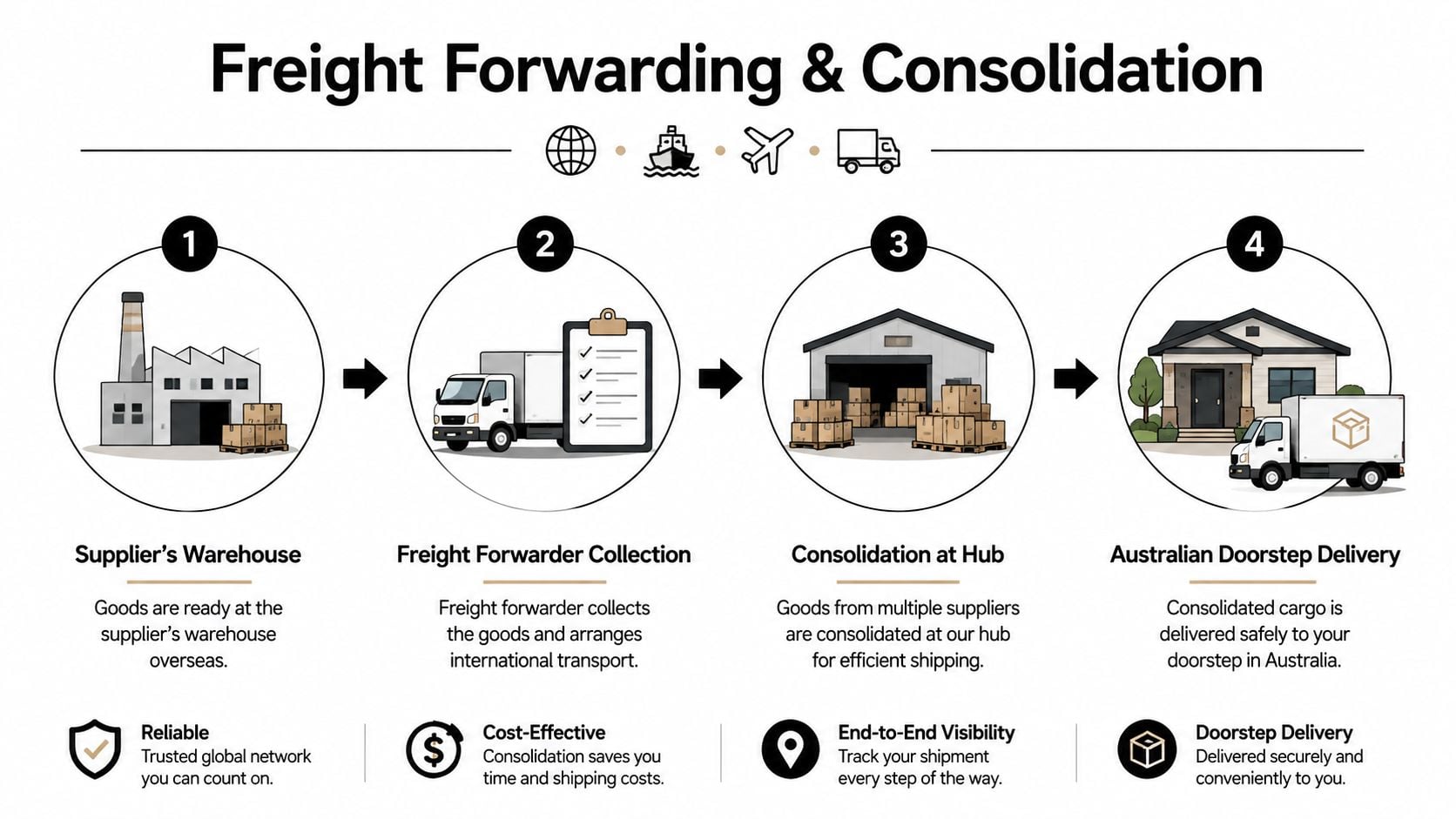
The value of that coordination is visibility. If a supplier sends an incomplete packing list, the issue can be found before cargo reaches the port. If several vendors use different carton sizes, the warehouse can measure and organise the freight before a final booking is made.
Consolidation saves money only when the warehouse receives, identifies and measures every parcel accurately.
Two consolidation methods
Package merging combines multiple parcels from one shopper or business into a single outbound shipment. It can remove duplicated outer packaging and create one customs documentation set, subject to the goods and destination rules.
Buyer consolidation combines LCL cargo from different importers into shared container space. Each shipment remains separately documented, but the transport capacity is shared. This approach suits importers whose stock is too large for parcel forwarding but too small for FCL.
Consider an Australian e-commerce seller receiving samples from five Guangzhou suppliers. Rather than sending five separate international shipments, the seller can route the parcels to a forwarder's warehouse, check the cartons, merge compatible packages and make one LCL booking. The potential saving can be substantial, but the exact result depends on dimensions, chargeable volume, destination fees and the time spent waiting for all suppliers.
For sellers combining procurement with fulfilment planning, ای کامرس سروسز can form part of the wider workflow. The forwarder should still confirm what is included, particularly storage, inspection, repacking, returns and final delivery.
A short visual explanation can help new importers understand the handoffs:
Navigating Australian Customs and Documentation
Australian import clearance depends on accurate information, not just on paying a freight invoice. The Australian Border Force manages border controls, while the Department of Agriculture, Fisheries and Forestry applies biosecurity requirements to goods that may carry pests, soil, disease or undeclared organic material.
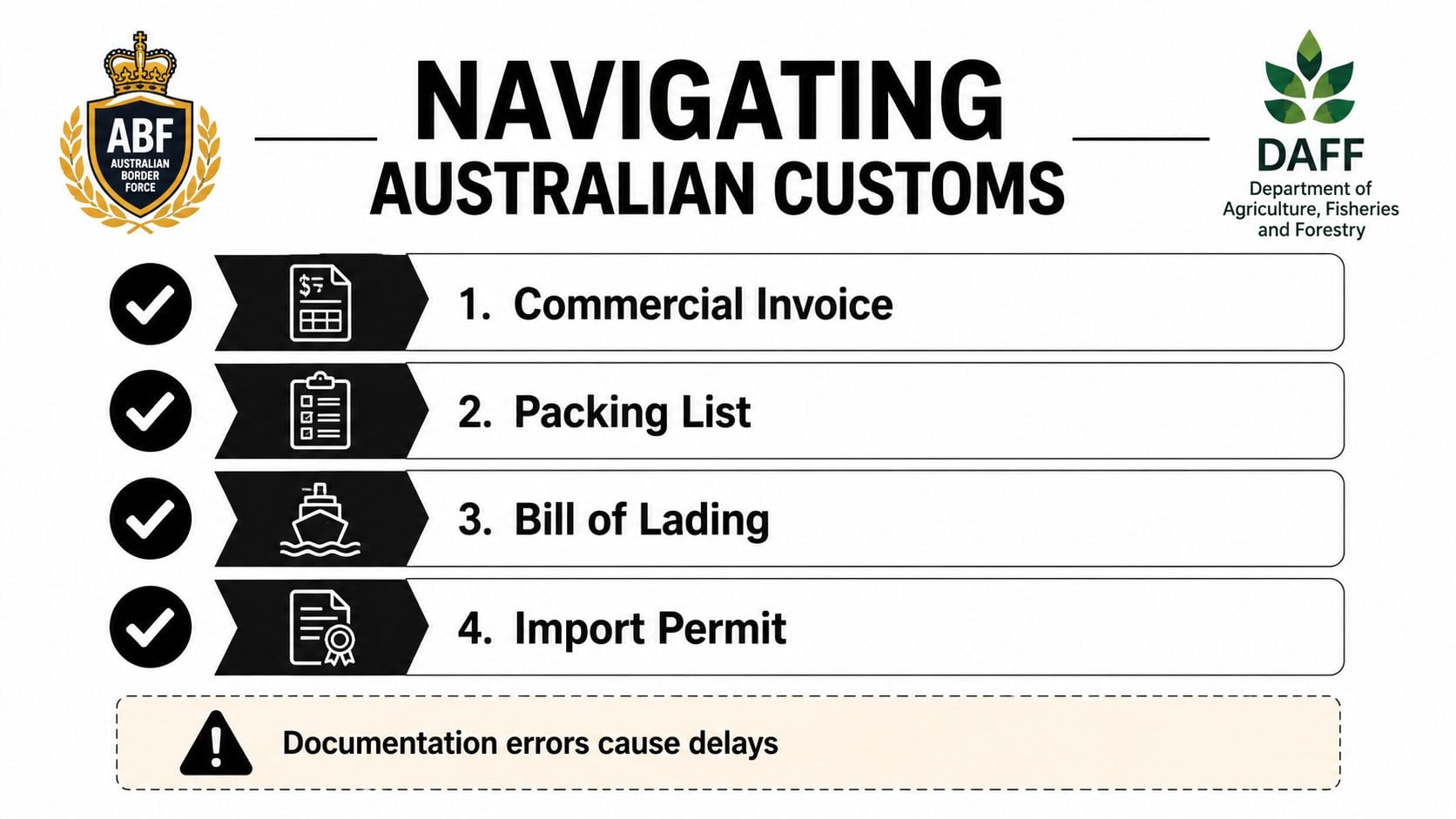
Start the document review before the supplier hands cargo to the carrier. The core file commonly includes a commercial invoice, packing list, bill of lading or airway bill, relevant permits and, where applicable, origin evidence or treatment documentation.
The paperwork that prevents avoidable holds
- تجارتی رسید: Use a clear description, realistic value, seller and buyer details, currency, Incoterms and country of origin. The تجارتی انوائس کی ضروریات کا رہنما is useful when supplier invoices are incomplete.
- پیکنگ کی فہرست: Match carton numbers, quantities, weights and dimensions to the physical cargo. Customs and warehouses need to know what is inside each package.
- نقل و حمل کی دستاویز: Check consignee, notify party, ports, marks and numbers. Errors can delay release or create delivery confusion.
- Permits and treatment evidence: Organic materials, timber packaging, food, plant products and animal-derived goods may need permits, inspection or treatment. Don't assume a supplier's ordinary export paperwork satisfies Australian biosecurity rules.
HS classification deserves special attention. An incorrect tariff code can affect duty treatment, permits, admissibility and the way authorities assess the goods. Product descriptions such as “parts”, “accessories” or “general merchandise” are too vague for many commodities.
Import declarations and tax planning
۔ Import Declaration, or N10, is part of the formal import process for applicable cargo. Low-value goods have separate rules, and the brief's specified threshold is AUD 1,000. Self-Assessed Clearance may be relevant for eligible consignments, but the correct pathway depends on the cargo, value, importer and declaration circumstances.
Never undervalue goods to reduce tax. The invoice, purchase record, payment evidence and packing information should tell the same story. If authorities or a broker need clarification, a quick response is usually cheaper than leaving a container or parcel waiting while the record is corrected.
عام شپنگ کے اخراجات اور ٹرانزٹ ٹائمز
A freight quote is only useful when it explains the delivered scope. Base ocean or air freight may exclude origin handling, terminal handling, documentation, customs brokerage, biosecurity examination, storage, unpacking, delivery appointments and the final-mile carrier.
The same shipment can produce very different outcomes depending on whether the quote is port-to-port, door-to-port or door-to-door. For small businesses, the most important comparison is often the all-in landed logistics cost per sellable unit, not the advertised transport rate.
| روٹ | موڈ | تخمینی لاگت کی حد | ٹرانزٹ ٹائم | کلیدی سرچارجز |
|---|---|---|---|---|
| China to Sydney or Melbourne | LCL or FCL sea | اقتباس پر منحصر ہے۔ | Service and port schedule dependent | Origin handling, terminal handling, documentation, destination charges and delivery |
| China to Sydney or Melbourne | ایئر | اقتباس پر منحصر ہے۔ | Route and flight capacity dependent | Fuel, security, handling, customs and delivery |
| USA West Coast to Brisbane | سمندر یا ہوا | اقتباس پر منحصر ہے۔ | Route, transhipment and service dependent | Terminal, fuel, currency, customs and inland delivery |
| UK or Europe to Fremantle | سمندر یا ہوا | اقتباس پر منحصر ہے۔ | Route and service dependent | Origin handling, carrier surcharges, biosecurity and delivery |
| Australian interstate movement | Road or rail | اقتباس پر منحصر ہے۔ | Lane, appointment and equipment dependent | Fuel, accessorials, storage, waiting time and regional delivery |
Why quotes change after booking
Carriers and forwarders may apply fuel-related charges, currency adjustment factors, peak surcharges, terminal fees or destination accessorials. The exact amount varies by route, carrier, timing and cargo profile, so a responsible quote should identify which items are included and which remain variable.
Consolidation can improve the economics of LCL freight by sharing transport capacity, but it can also introduce a cut-off dependency. If one supplier misses the warehouse receiving date, the shipment may move without that cargo or wait for the next suitable departure. The right choice depends on the stock's urgency and the cost of delay.
For a shipment costing exercise, request two versions of the quote:
- Transport-only: Useful for comparing carrier and mode pricing.
- Delivered estimate: Includes origin charges, destination charges, customs handling, taxes where applicable, storage assumptions and final-mile delivery.
Ask the provider to state the quote's validity, measurement basis and excluded charges. A cheap rate with unclear exclusions isn't a budget.
E-Commerce Fulfillment and Amazon Prep Services
International sellers often focus on getting stock into Australia and leave the operational work until the cartons arrive. That approach creates avoidable handling, especially when products need inspection, relabelling, protective packaging, marketplace preparation or returns processing.
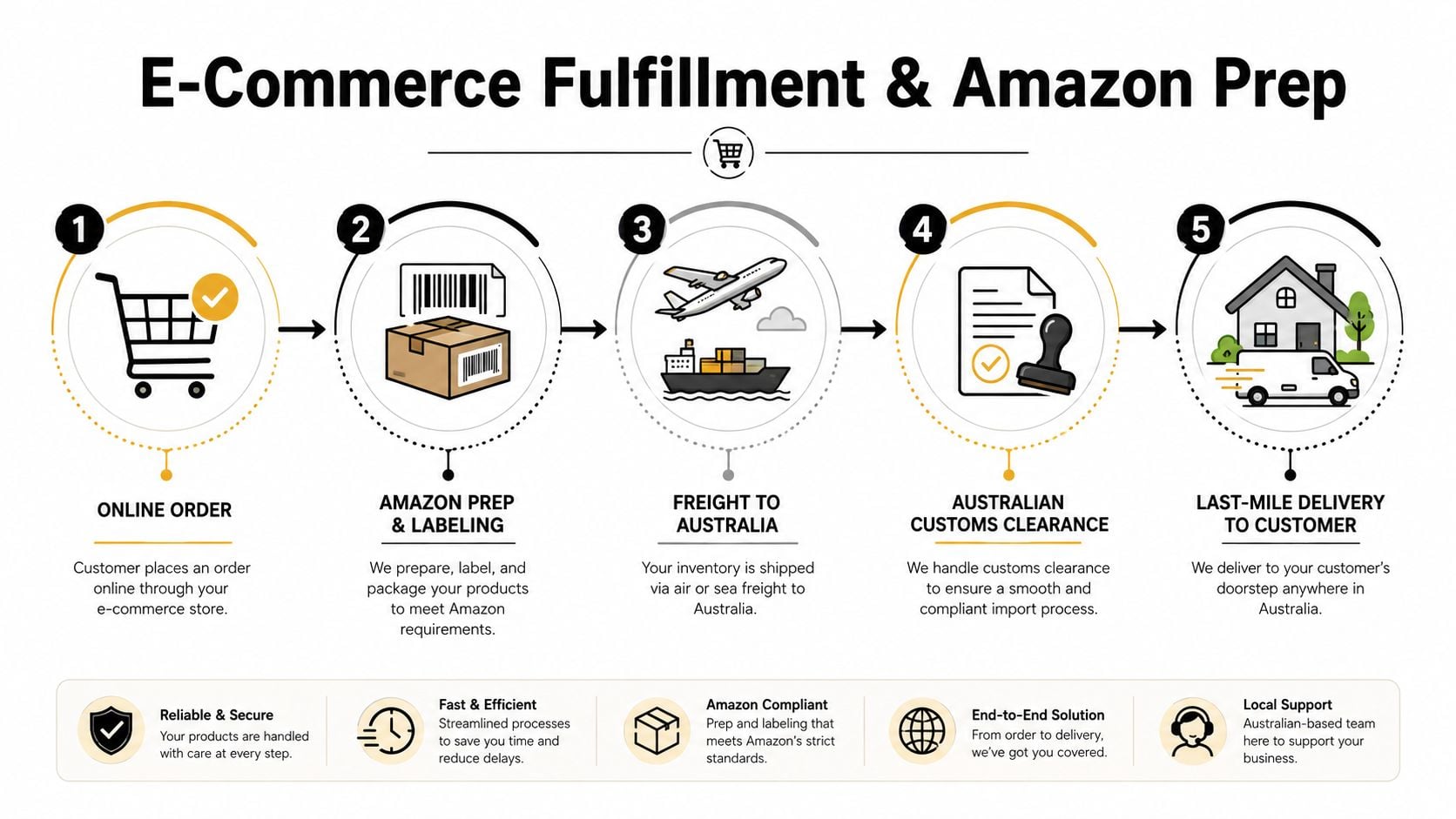
A sensible workflow begins at the overseas supplier. The seller provides the SKU list, carton contents, product dimensions, labelling requirements and receiving instructions before the shipment departs. The Australian warehouse then receives the freight, records inventory, checks visible condition and prepares goods for the chosen sales channel.
A workable seller workflow
A seller shipping stock to Amazon Australia may need:
- FNSKU application: Product and carton labels must match the seller's inventory setup.
- Poly bagging: Products requiring a bag should receive suitable packaging and the required suffocation warning.
- Bubble wrapping: Fragile products need protection that can withstand handling between warehouse, carrier and fulfilment centre.
- Case configuration: Cartons should be organised to match the marketplace shipment plan and avoid unnecessary rework.
- واپسی ہینڈلنگ: Returned goods need inspection, grading, relabelling or disposal instructions.
The practical details of ایمیزون کی تیاری کی خدمات matter because a shipment can be physically correct yet operationally unusable if labels, carton quantities or packaging don't match the inbound plan.
Fulfilment beyond Amazon
A local warehouse can support dispatch to Amazon, eBay, Shopify customers or wholesale buyers from the same inventory pool. That reduces the need to split stock across disconnected locations, though the seller must set reorder points and decide how much inventory to hold locally.
A mid-volume seller can structure the pipeline around scheduled receiving, inspection, prep, inventory updates, marketplace allocation and dispatch. The warehouse should report exceptions promptly, such as carton damage, quantity mismatches or products that need a compliance decision. Those checks are more valuable than storing boxes.
The commercial trade-off is storage cost versus delivery responsiveness. Holding stock closer to customers can simplify domestic fulfilment, but it ties up working capital and requires disciplined forecasting. Sellers should model storage, prep, pick and pack, returns and delivery together before choosing a warehouse arrangement.
صحیح لاجسٹک فراہم کنندہ کا انتخاب کیسے کریں۔
A logistics provider should be assessed by what happens when the shipment isn't straightforward. Anyone can quote a clean carton with a known origin and destination. The test is whether the provider can explain the response to a documentation error, a missed vessel, a biosecurity inspection, damaged packaging or a delivery appointment failure.
Use a simple evaluation scorecard:
- کسٹم کی صلاحیت: Ask who prepares or reviews declarations and how classification questions are escalated.
- Gateway coverage: Confirm operational support near the Australian port most relevant to your destination.
- Consolidation control: Check receiving cut-offs, warehouse measurements, package photos and treatment of late supplier cargo.
- قیمتوں میں شفافیت: Request included services, exclusions, storage terms, destination charges and quote validity in writing.
- Disruption communication: Find out who sends updates and what information appears when a schedule changes.
Red flags in a quote
A provider that quotes without asking for dimensions, weights, commodity details or delivery requirements is guessing. The same applies to an operator that can't describe its biosecurity process or explain who handles customs queries.
Budget parcel consolidators can work for simple, low-risk shipments. They become less attractive when goods are bulky, regulated, fragile, multi-supplier or commercially time-sensitive. Missed consolidation windows, unclear storage charges and repeated document corrections can cost more than a higher initial forwarding fee.
For specialist cargo, compare the provider's process with the service level you need. A company shipping urgent hydraulic components may also find it useful to review the operational considerations behind same-day hydraulic deliveries, particularly around collection timing, equipment access and communication.
A provider such as AUSFF can coordinate package consolidation, air and sea freight, customs support, warehousing and e-commerce preparation. That doesn't remove the need to verify the quotation, commodity restrictions or importer responsibilities. It gives the shipper one operational point to coordinate the separate stages.
Planning Your Next Shipment From or To Australia
Start with the shipment profile, not the carrier. Record the supplier or retailer, collection address, destination, number of packages, dimensions, weights, commodity, value, delivery deadline and whether multiple purchases can be held for consolidation.
An international shopper buying from several Australian retailers should first obtain a local receiving address, then ask each retailer to use the correct recipient reference. Once the parcels arrive, the warehouse can identify compatible packages, remove unnecessary outer packaging and compare air and sea dispatch options.
An SMB importing inventory should confirm product classification, packaging, permits and carton data before the supplier finishes production. Request a consolidated quote with origin collection, export handling, main transport, Australian clearance and final delivery shown as separate lines. That format makes it easier to identify the cost of changing from LCL to FCL or from sea to air.
An Amazon seller should prepare the inbound shipment plan before stock leaves the origin. Labels, carton configuration, prep instructions and Australian warehouse receiving requirements should be agreed in advance, not after the goods reach the terminal.
Use this pre-shipment checklist:
- Measure every package: Confirm actual dimensions and weights, including irregular or oversized pieces.
- Verify classification: Check the HS code, product description and any permit requirement.
- Screen the cargo: Review prohibited, restricted, hazardous and biosecurity-sensitive items.
- دستاویزات تیار کریں: Match invoices, packing lists, transport documents and origin evidence.
- Plan the buffer: Allow time for port, customs, biosecurity, warehouse and delivery variables.
- Review cover: Ask what insurance or carrier liability applies and where exclusions sit.
Australia's freight network rewards organised shippers. Surely we can assist when you need a coordinated plan for consolidation, air freight, sea freight, customs handling, e-commerce fulfilment or delivery from an Australian address.
AUSFF can receive Australian purchases, consolidate packages, coordinate international air or sea freight, and support businesses with customs, warehousing, fulfilment and Amazon preparation services. Visit اے یو ایس ایف ایف with your cargo details, origin, destination and preferred timing so the shipment can be assessed around its real delivered requirements.