
You've got the bike sold, the relocation is locked in, or the long ride is finally happening, and now the hard question lands on your desk. How do you move a motorcycle across borders without paying for avoidable handling, customs delays, or damage that shows up at the destination dock?
In okeere gbigbe ọkọ alupupu, the job is never just booking transport. It's matching the right mode to the route, preparing the bike so a port won't reject it, and lining up the paperwork so the destination country can release it. In Australia, that matters even more because the local market is large, trade volumes are real, and the difference between a smooth handover and a stalled shipment usually comes down to the details. Australia had about 1.16 million registered motorcycles in 2023, after Awọn iforukọsilẹ 1,130,000 in 2022, and the Australian Bureau of Statistics reported $ 1.7 bilionu in imports of motorcycles and mopeds in 2023, which shows this isn't a niche lane at all, but a well-used commercial flow with recurring import, export, relocation, and touring movements. That scale is why preparation, consolidation, and door-to-door handling matter so much in the AU market. The Australian Automobile Association figures and the ABS trade value give you the context for why the lane is busy and why the paperwork chain gets watched so closely. Australian motorcycle registration and import trade figures
The three decisions that usually make or break the shipment are simple to say and expensive to ignore, the transport mode, the bike prep, and the document chain.
Atọka akoonu
- Why International Motorcycle Shipping From Australia Is Worth Planning Carefully
- Choosing Between Air, Sea, RORO, and Container Shipping
- Preparing the Bike for a Safe Handover
- Documents and Customs Paperwork for Motorcycle Shipping
- Insurance, Damage Risk, and What Happens at the Destination Port
- Realistic Costs, Timelines, and How to Read a Shipping Quote
- Common Pitfalls and a Practical Action Plan Before You Book
Why International Motorcycle Shipping From Australia Is Worth Planning Carefully
A rider calls after a sale gets signed in Singapore, or a relocation notice lands with a departure date that's closer than expected. The bike is valuable, the buyer wants it intact, and the clock starts the moment someone says, “Can you just ship it over?” That's where the work begins, because motorcycle shipping international is nothing like sending boxed freight.
The bike is cargo, but not ordinary cargo
A motorcycle has exposed fairings, protrusions, fluids, a battery, and a frame that can dent if a strap point is wrong. At both ends of the move, it also sits inside a compliance environment, not just a transport lane. That means the operator is dealing with loading safety, customs, and destination release as separate issues, not one bundle.
Australia makes this even more relevant because the market is deep enough to support regular export and import movements, not just one-off enthusiast shipments. The country's registered fleet and import value figures show a mature two-wheeler ecosystem with ongoing trade. In practical terms, that translates to routine demand for sea freight, consolidation, and door-to-door handling, especially when riders are balancing cost against how much handling the bike can tolerate.
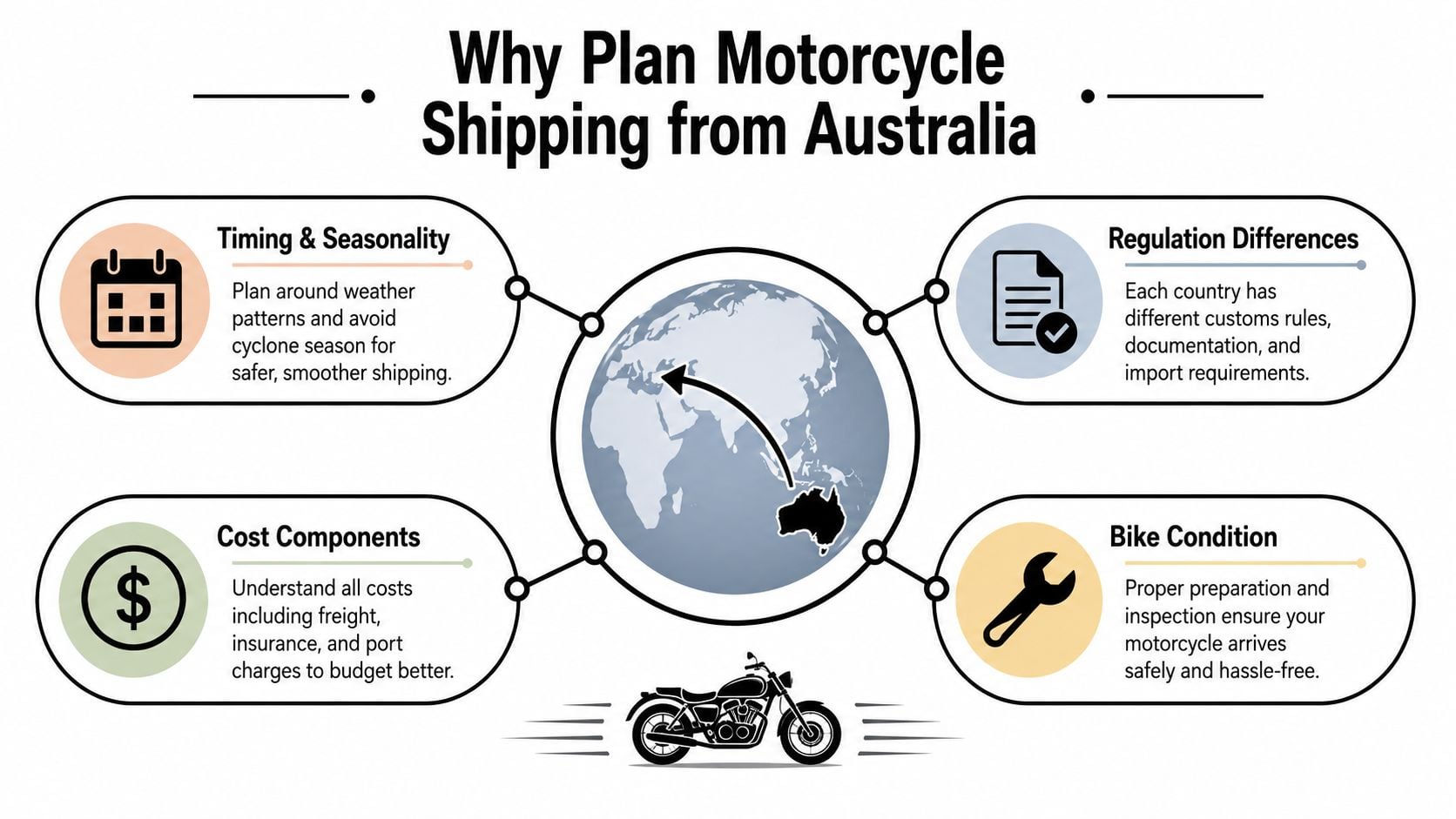
The first fork in the road is always mode, prep, and paperwork
The transport mode shapes the entire shipment. Air freight can solve urgency, sea freight can lower cost, and container or RORO choices change how much the bike is handled. The wrong answer here doesn't just affect price, it changes how the bike gets packed, whether it needs crating, and what the destination inspector will see.
The second fork is preparation. A bike that arrives with fuel, loose accessories, or a battery left connected creates avoidable port risk and often more inspection friction. The third is documentation, because a correct booking can still stall if the ownership record, import approval, or customs paperwork is incomplete.
If the bike is going out of Australia, think like a port officer, not a rider. The question isn't whether the bike runs. It's whether it can move safely, be identified clearly, and clear the next authority without a hold.
The smart way to approach the shipment is to treat those three decisions as one chain. Once one link is wrong, the rest gets slower, more expensive, or harder to prove if something goes missing.
Choosing Between Air, Sea, RORO, and Container Shipping
The best shipping mode is the one that fits the route and the paperwork, not the one that sounds best in a quote. On an Australia-origin move, that means weighing freight cost against ADR treatment, biosecurity cleaning, Vehicle Import Approval timing, and how much handling the bike will see once it leaves Sydney or lands at the destination port.
Air freight suits urgency, not casual price-shopping
Air is the fastest option, but it usually brings the strictest fuel and battery treatment. Independent shipping guidance notes that motorcycles moved by air are commonly treated as dangerous goods because of the fuel and battery, and one Australia-based shipping guide says the tank must be drained to about 1 litre of fuel ati awọn ge asopọ batiri with the leads taped to comply with international shipping and air-freight rules. Motorcycle air-freight safety requirements
That makes air useful when the bike needs to arrive quickly for a sale, event, or urgent relocation. It is a harder sell when the rider is chasing the lowest landed cost, because the packing standard is tighter, the handling rules are stricter, and the freight line is usually steeper.
Sea freight works when the bike can wait for the sailing
Sea freight is the lane most riders think of first for non-urgent moves, especially when the bike can be consolidated with other cargo. Òkun Òru is a cost-effective method of transporting goods internationally using ocean vessels and container ships, and that model suits motorcycles well when the owner wants a balance between cost and control. In practice, it suits long-haul relocation, touring prep, and many private sales where the owner can live with a slower departure and a longer port process.
RORO sits in a different place. It is the simplest drive-on, drive-off concept, and how RORO shipping works matters because the bike travels with less packing but also less protection than a crate or a sealed box. Dedicated containers sit at the other end of the spectrum, especially for classic, high-value, or heavily modified bikes that justify full crating and proper lashing.
| mode | Aṣoju Transit | Cost Band | Mimu Ewu | Ti o dara ju Fun |
|---|---|---|---|---|
| Ẹru ọkọ ofurufu | Sare ju | O ga julọ | Lower time in transit, stricter prep | Urgent moves, high-pressure deadlines |
| RORO | dede | Aarin ibiti | More exposure than a container | Straightforward bikes, simple handovers |
| LCL okun ẹru | O lọra ju afẹfẹ lọ | Lower than dedicated options | Shared handling, more consolidation touchpoints | Owners sharing space to control cost |
| Ifiṣootọ eiyan | Moderate to slower | Higher than shared sea options | Lowest exposure once secured | Classic, valuable, or modified bikes |
When the route is cost-sensitive and the bike is not fragile or time-critical, shared sea movement often makes sense. When the route is awkward, the bike is valuable, or the receiver does not want multiple touches, a dedicated container is the cleaner answer. In Sydney, consolidation can also change the final landed cost because the bike may sit in a shared load before it gets sealed, lifted, and sent out, and that can be cheaper than booking space alone if the timing lines up. For riders who are also dealing with storage before export, a complete seasonal storage guide like the one at complete seasonal storage guide can help frame how long a bike can sit while paperwork and freight are being arranged.
Preparing the Bike for a Safe Handover
Most claims, delays, and arguments start before the bike leaves the workshop. The handover either creates a clean evidence trail or it doesn't, and once the bike gets wrapped, strapped, or crated, the chance to fix an omission is gone.
Start with fuel, battery, and loose parts
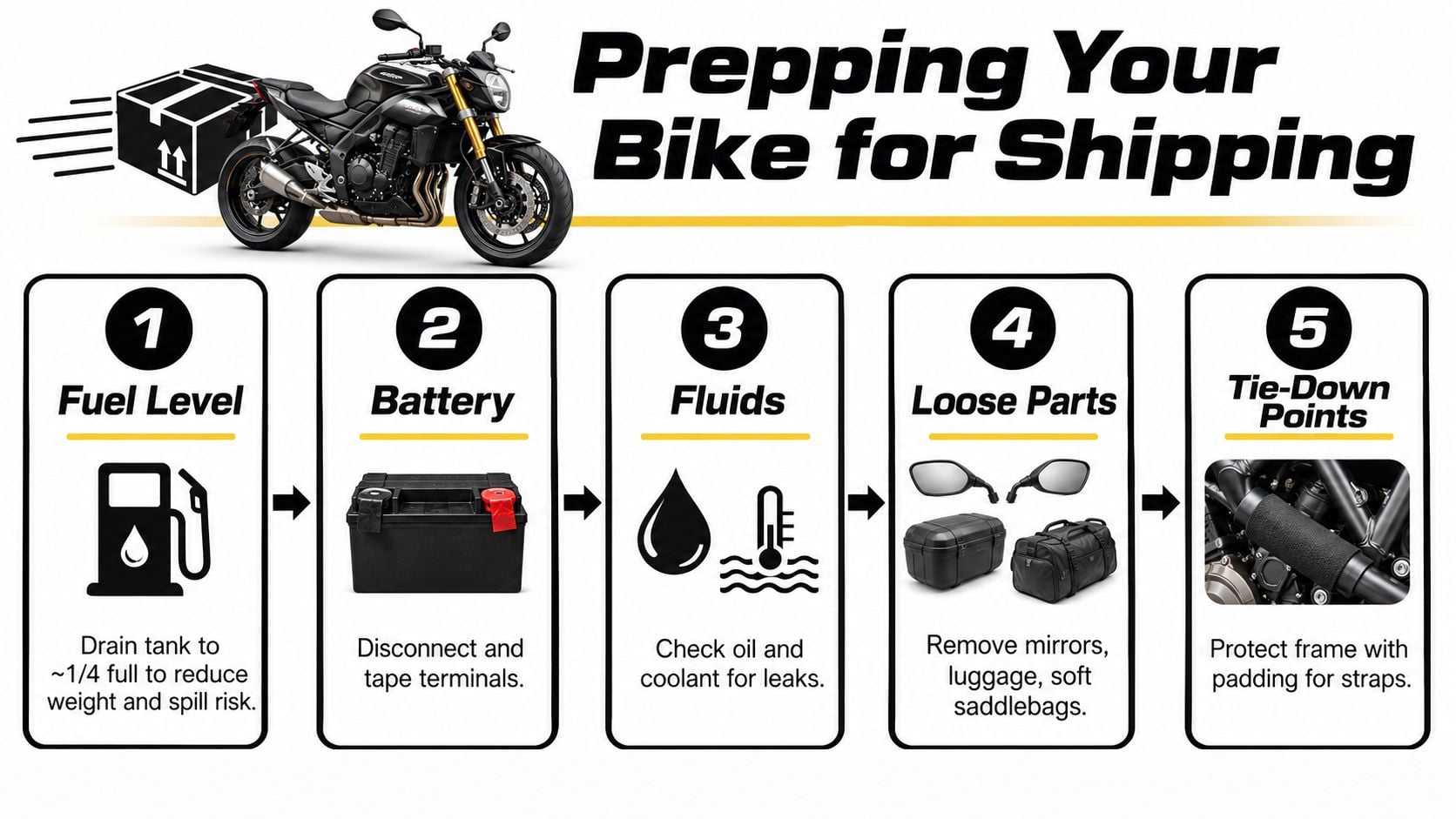
For sea freight in Australia, carriers commonly want the tank reduced to no more than 1/4 full, and some operators advise leaving only about 2 liters in the tank. The battery should be disconnected, and loose accessories should come off before loading begins. That isn't just bureaucracy. It reduces spill risk, lowers the chance of a port safety rejection, and stops a pannier, mirror, or GPS cradle from becoming the first thing that gets broken.
The bike should also be washed thoroughly. Biosecurity expectations are real, and a dirty undercarriage or chain area can slow clearance if the destination treats residue as a risk. The cleaning step matters because the port officer or inspector is trying to see the machine clearly, not guessing what's hidden under road grime.
Photograph it before anyone touches a strap
Take dated photos from every angle before packing starts. Get the front fairing, the exhaust side, the rear, the control cluster, and the tank. That record is the difference between a claim that can be evidenced and one that turns into a debate over what was already there.
A clean condition report beats a good memory every time.
The packing method then depends on the lane. Crating gives the most enclosure, soft-tie lashing works where the bike needs controlled restraint, and a dedicated motorcycle skid helps keep the bike stable through loading and transit. If the shipment is going through a consolidation point, it's smart to let the freight provider handle the build, but insist on being present or sending clear photos if the bike is especially valuable or already has cosmetic blemishes. A seasonal storage checklist such as SwiftJet's complete seasonal storage guide is useful here because the same habits, keeping the bike clean, documented, and immobilised properly, also reduce shipping headaches.
There's also a good fit for riders who already manage complex online logistics. AUSFF's Awọn iṣẹ iṣowo e-commerce are designed for boxed freight and fulfilment work, and the same operational discipline around photos, labelling, and consolidation is exactly what a bike shipment needs, just with heavier gear and stricter handling.
Documents and Customs Paperwork for Motorcycle Shipping
A lot of riders think paperwork starts when the freight company asks for it. In reality, the document stack starts at origin, then gets checked again at export, then gets tested once more at destination customs. If one piece is missing, the shipment can sit while everyone else waits.
Ownership, identity, and export records come first
At origin, the carrier needs proof that the bike belongs to the sender or the sender has the right to move it. That usually means registration and a bill of sale or title, depending on the lane and the destination market. Identity documents sit alongside that, because customs doesn't care how shiny the bike is if the ownership trail is weak.
For temporary movement, a Carnet de Passages-type solution is commonly tied to stays of labẹ 12 osu, while permanent or long-term import cases generally rely on ownership paperwork such as title or registration documents. That split matters because temporary touring and permanent import follow different customs paths, and mixing them up causes avoidable delays. Motorcycle shipping documents and ownership pathways
Australia has a different import gate, and the timing matters
For motorcycles entering Australia, a Vehicle Import Approval from the Department of Infrastructure is required ṣaaju ki o to sowo, not after arrival, and the approval process typically takes meji si mẹrin ọsẹ. The Australian framework also applies GST ni 10% to the customs value even when a duty exemption is available under the removal-goods pathway. Australian VIA timing and GST treatment
That timing can stop a bike before it even gets loaded, so it's not an afterthought. It's the gate that tells you whether the shipment is cleared to start. If the bike is leaving Australia, a freight partner with customs consultancy can also flag tariff classifications and duty drawback angles that riders often miss, which is where a controlled export process becomes more than just a booking.
One useful source of practical paperwork detail is AUSFF's awọn ibeere iwe-owo iṣowo, because invoice accuracy is one of the fastest ways to keep customs from asking follow-up questions.
Insurance, Damage Risk, and What Happens at the Destination Port
Insurance gets treated like a checkbox too often. It shouldn't. Carrier liability and marine cargo cover do different jobs, and if the wrong one is relied on, a damage claim can turn into a dead end even when the bike clearly took a hit.
What the cover usually needs to match
Standard carrier liability is not the same thing as an all-risk marine cargo policy. The first is usually narrow and tied to the carrier's terms, while the second is designed to address a broader set of shipment risks. If the bike suffers a forklift knock at port, a loose fairing during vibration, or handling damage during consolidation, the pre-shipment condition record is what helps establish whether the claim has legs.
That's why the earlier photos matter so much. If a mirror was already scuffed or a pannier already bent, the claim argument gets messy quickly. A clean condition report, paired with dated images, gives the receiver something concrete to compare against at the destination.
The destination port still has its own sequence
Once the container or bike lands, it's not immediately road-ready. Port handling comes first, then customs inspection, then any required cleaning or release steps. If the bike is arriving into Australia, biosecurity checks may follow because used vehicles and machinery are treated as possible contamination risks. From there, the local registration process decides whether the bike can legally be ridden.
If you want a deeper read on how loss values can shift after damage, Auto Appraisals' motorcycle salvage penalty tips are useful because they show why cosmetic damage, frame issues, and poor documentation can hit value much harder than owners expect.
Door-to-door service shortens this stage because the receiver gets one coordinated handover instead of a crate sitting on a dock while separate handlers and customs processes unwind around it. That doesn't remove port work, but it does make the handover cleaner.
For a practical look at liability wording, AUSFF's iṣeduro gbese ẹru is the kind of page that helps riders separate transport risk from paperwork risk before they commit.
Realistic Costs, Timelines, and How to Read a Shipping Quote
A good motorcycle quote doesn't need to be the cheapest. It needs to explain what's included, what isn't, and where the extra charges will appear if the shipment gets delayed or diverted. The easiest way to sanity-check a quote is to split it into five pieces.
Read the quote line by line
First is origin handling, which covers collection, warehouse intake, photos, and preparation for loading. Second is freight itself, whether that's air, RORO, or sea. Third is destination charges, which often show up after the bike arrives and can include terminal work, agent handling, or storage if customs slows the release.
The fourth piece is insurance. The fifth is duties, taxes, or GST depending on the destination country and the import pathway. If those five buckets aren't visible, the quote is incomplete no matter how tidy the total looks.
Timelines move with consolidation and customs, not just distance
Air is the fastest option, but the timing can still stretch if documents aren't ready or the bike isn't prepped correctly. Sea freight and RORO depend more on sailing schedules, consolidation timing, and destination congestion. A bike that waits for the next container slot can sit longer than expected even when the ocean leg itself is efficient.
The quote that looks cheap at booking often gets expensive when the shipment lands and the missing charges appear locally.
That's where an operator with consolidation, freight negotiation, and customs support can make the whole move easier to interpret. AUSFF's role is to connect those pieces, particularly out of Sydney, where daily consolidation and multiple freight options can be lined up around the route rather than forcing the rider into a single box. The point isn't to oversell one mode, it's to make sure the quote matches the handover, the destination process, and the level of handling the bike can tolerate.
Common Pitfalls and a Practical Action Plan Before You Book
The same mistakes show up again and again, and they're usually avoidable. The bike goes to port without photos, the battery stays connected, the owner assumes insurance covers everything, or the paperwork is built for touring when the shipment is a permanent import.
The usual traps are boring, and that's why they work
Skipping the pre-shipment photo set weakens a claim before it starts. Forgetting to disconnect the battery can trigger compliance problems. Ignoring the difference between temporary movement and permanent import can leave the receiver with the wrong customs pathway.
Treating the booking as a one-off transaction is another common mistake. Motorcycle shipping international works best when origin handling, customs, and destination release are coordinated as a chain, not three separate jobs with three different assumptions.
A simple booking checklist keeps the move sane
- Confirm the transport mode: Match the route to the bike, the deadline, and the amount of handling you'll tolerate.
- Lock in the import approval path: If the bike is entering Australia, make the VIA timing part of the plan before loading.
- Prepare and document the bike: Clean it, reduce fuel, disconnect the battery, remove loose items, and photograph every side.
- Arrange the right insurance: Don't assume carrier liability is the same as broad cargo cover.
- Choose one point of contact: Use a freight partner that can coordinate consolidation, customs consultancy, and door-to-door delivery through the same channel.
That last point is where a practical operator matters. AUSFF handles air, sea, RORO, and project logistics out of Sydney, so the shipment can be managed from the handover side through to the destination side without the rider having to chase separate parties for every step. If you're ready to move a bike overseas, compare the route, line up the documents, and visit AUSFF to start a proper shipping conversation with a team that works these lanes every day.